
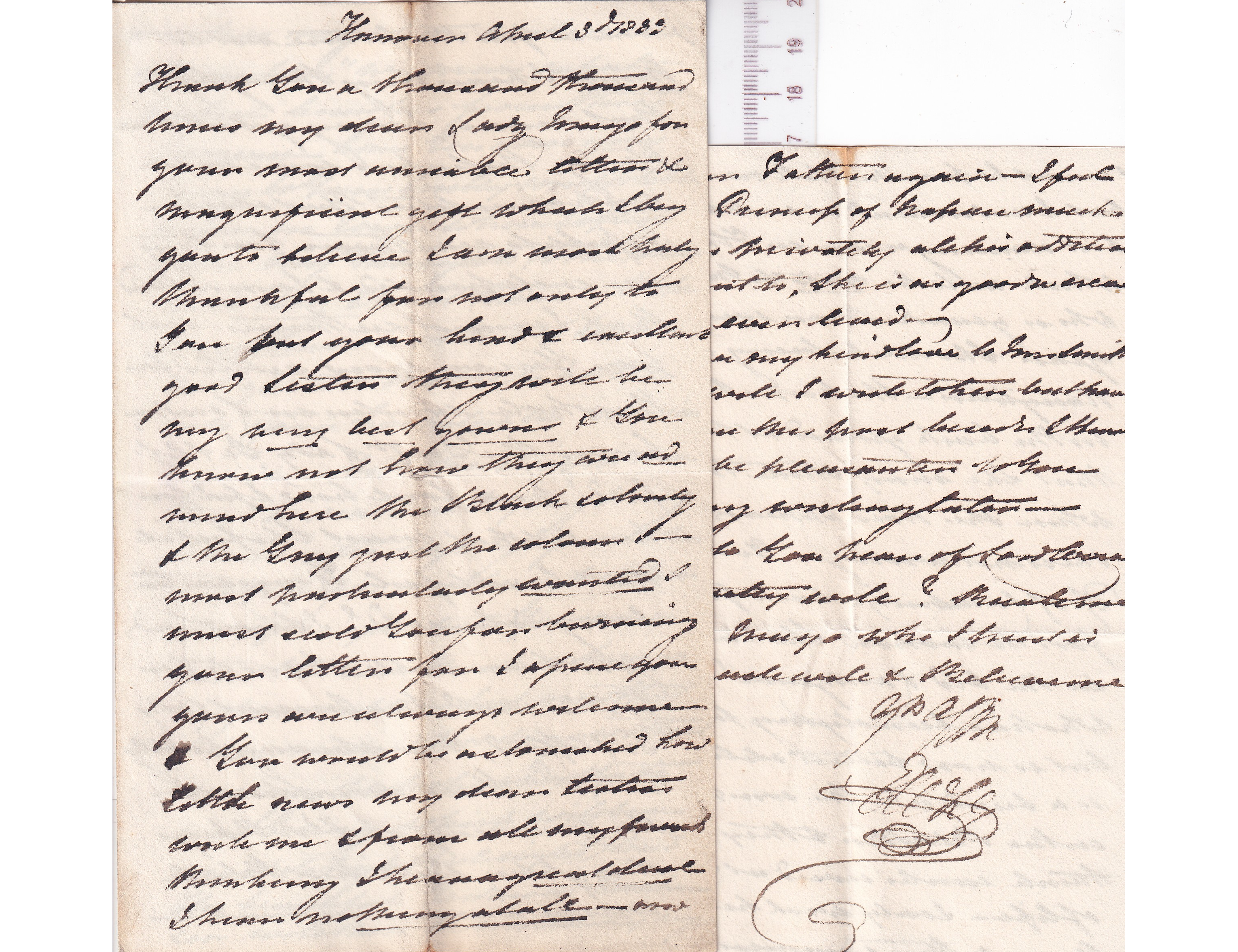
1833 PRINCESS ELIZABETH – DAUGHTER OF KING GEORGE III – SUBSTANTIAL 6-PAGE ROYAL AUTOGRAPH LETTER SIGNED “ELIZA”
A substantial and fascinating Autograph Letter Signed (ALS) by Princess Elizabeth, Landgravine of Hesse-Homburg (1770–1840), seventh child and third daughter of King George III and Queen Charlotte.
Written at Hanover on 3 April 1833, this lengthy letter is written across six of the eight pages of two 4-page lettersheets, and concludes with Princess Elizabeth’s large and distinctive “Eliza” signature with elaborate flourish.
The recipient is Arabella Mackworth-Praed, Countess of Mayo (c.1766–1843), wife of John Bourke, 4th Earl of Mayo, and a lady-in-waiting to Queen Adelaide, wife of Elizabeth’s brother King William IV.
The letter is remarkably personal and wide-ranging, combining royal and aristocratic news with fashion, health, art, Hanover society and family gossip.
Elizabeth opens affectionately:
“Thank You a thousand thousand times my dearest Lady Mayo for your most amiable letter & magnificent gift…”
She enthusiastically thanks Lady Mayo and her sister for sending velvet and grey material for gowns, saying they will make her “very best gowns” and are greatly admired in Hanover. She scolds Lady Mayo for burning her letters and complains that her own royal sisters provide surprisingly little news.
Elizabeth then gives an unusually personal account of her health. Newspapers arrive in such quantities and are so poorly printed that:
“I am so blind that I cannot see them.”
She also complains of rheumatic legs, poor weather preventing her from walking, and states:
“I paint when it is possible.”
This is particularly characteristic of Princess Elizabeth, who was an accomplished artist and engraver.
LADY DE CLIFFORD & THE BREAK-UP OF KINGS WESTON
One of the most historically interesting passages concerns the recently widowed Mary Elizabeth Southwell, Baroness de Clifford, née Bourke, and the impending sale and dispersal of the historic Kings Weston estate near Bristol.
Elizabeth sympathetically asks what Lady de Clifford must feel at:
“that beautiful Kingsweston being to be sold”
and refers to her foster child:
“the present Lady De Clifford.”
The timing is particularly significant. Edward Southwell, 21st Baron de Clifford, had died childless on 30 September 1832, causing the ancient barony to fall into abeyance. That abeyance was terminated in favour of Sophia Russell, 22nd Baroness de Clifford, by letters patent dated 4 March 1833.
Elizabeth wrote this letter on 3 April 1833, only 30 days later, making her reference to the “present Lady De Clifford” exceptionally current aristocratic news.
Kings Weston itself was undergoing a remarkable dispersal following Lord de Clifford’s death. Its furniture, pictures, artworks, plate, books and ultimately its historically important manuscripts and autograph letters were dispersed through a succession of sales during 1833–34. Elizabeth’s sympathetic comment therefore refers not merely to the sale of a country house, but to the break-up of a historic family establishment and its collections.
LORD ERSKINE FAMILY GOSSIP
The letter also contains a striking piece of contemporary society gossip concerning a daughter of Lord Erskine, very probably David Montagu Erskine, 2nd Baron Erskine.
Responding to Lady Mayo’s description of:
“the marriage of Ld Erskines daughter with her Black cousin”
Elizabeth jokes:
“as ‘two negatives make an affirmative’ we may expect perfect beauties from their progeny.”
The particular daughter concerned has not been conclusively identified and is therefore deliberately left unattributed. The quoted wording is retained as contemporary manuscript language.
HANOVER IN TRANSFORMATION
Elizabeth gives particularly interesting first-hand observations of Hanover during a period of considerable urban redevelopment.
She tells Lady Mayo that Hanover has greatly improved since her previous visit, specifically mentioning Georgstraße and Friedrichstraße, handsome new houses and fashionable public walks as the city expanded beyond its older boundaries.
She discusses a grand new residence being built by Count zu Innhausen und Knyphausen and extensive building work being undertaken by Hanoverian minister Kaspar Detlev von Schulte, whose enlarged house Elizabeth says is expected to possess:
“the best dancing room in Hanover.”
She also describes frequent fashionable parties, including the Duke of Cambridge’s public Tuesdays, and the anticipated social debut of von Schulte’s daughter, creating a wonderfully informal picture of Hanoverian court and high society.
Elizabeth looks forward to better weather enabling her to visit the beautiful Herrenhausen Gardens.
DUKE & DUCHESS OF CAMBRIDGE – HESSE ROYAL FAMILY
The letter contains substantial British and German royal-family news.
Elizabeth discusses her younger brother Prince Adolphus, Duke of Cambridge, then serving as royal representative in Hanover, and his wife Princess Augusta, Duchess of Cambridge.
The Duchess is expected home from Frankfurt after visiting her seriously ill father, Prince Frederick of Hesse-Kassel (1747–1837).
Elizabeth writes frankly of his condition:
“The complaint is in the Bladder & they do not think can be cured at his time of life”
and fears:
“it is a break up.”
She hopes that the elderly Prince may at least survive the summer and remarks movingly:
“I am glad for the Dss she has had the comfort of seeing her Father again.”
Elizabeth’s fears proved premature: Prince Frederick survived for another four years, dying in 1837 aged 89. A grandson of King George II, he eventually became the last surviving legitimate grandchild of George II.
The letter additionally refers to a “Pss of Hesse”, apparently a Princess of Hesse enduring a private family affliction. The individual has deliberately been left unidentified rather than speculatively attributed.
Elizabeth closes with affectionate enquiries concerning Lord Mayo and other mutual acquaintances before signing with the large and striking:
“Eliza”
followed by an extensive flourish.
HISTORICAL INTEREST
This is considerably more substantial than the short polite or formal royal correspondence often encountered. Across six extensively handwritten pages, Princess Elizabeth discusses:
• gifts of velvet and grey material for her gowns
• her royal sisters and lack of news from Britain
• her seriously impaired eyesight
• rheumatism and difficulty walking
• her own painting
• London houses and society
• the newly settled de Clifford peerage succession
• the impending sale and dispersal of Kings Weston
• Lord Erskine family marriage gossip
• the physical transformation of Hanover
• Georgstraße and Friedrichstraße
• Herrenhausen Gardens
• fashionable Hanoverian houses and parties
• the Duke and Duchess of Cambridge
• the illness of Prince Frederick of Hesse-Kassel
• other private royal and aristocratic family matters
The fact that the letter was written only 30 days after Sophia Russell was declared Baroness de Clifford gives the de Clifford passage particular immediacy.
Together with its exceptional length, identified royal author and court recipient, intimate health comments, artistic reference, Hanover observations, Kings Weston material and extensive British and German royal-family content, this is an unusually rich Georgian royal autograph letter.
Condition as photos. Guaranteed Original. All items can be returned for a full refund if found to be not as described.
Provenance:
From a miscellaneous collection bought at auction. Guaranteed GENUINE.


Princess Elizabeth (May 1770 – Jan 1840), called Eliza, was the seventh child and third daughter of King George III and Queen Charlotte. After marrying the Landgrave of Hesse-Homburg, Frederick VI, she took permanent residence in Germany as landgravine.
Leave a Reply