
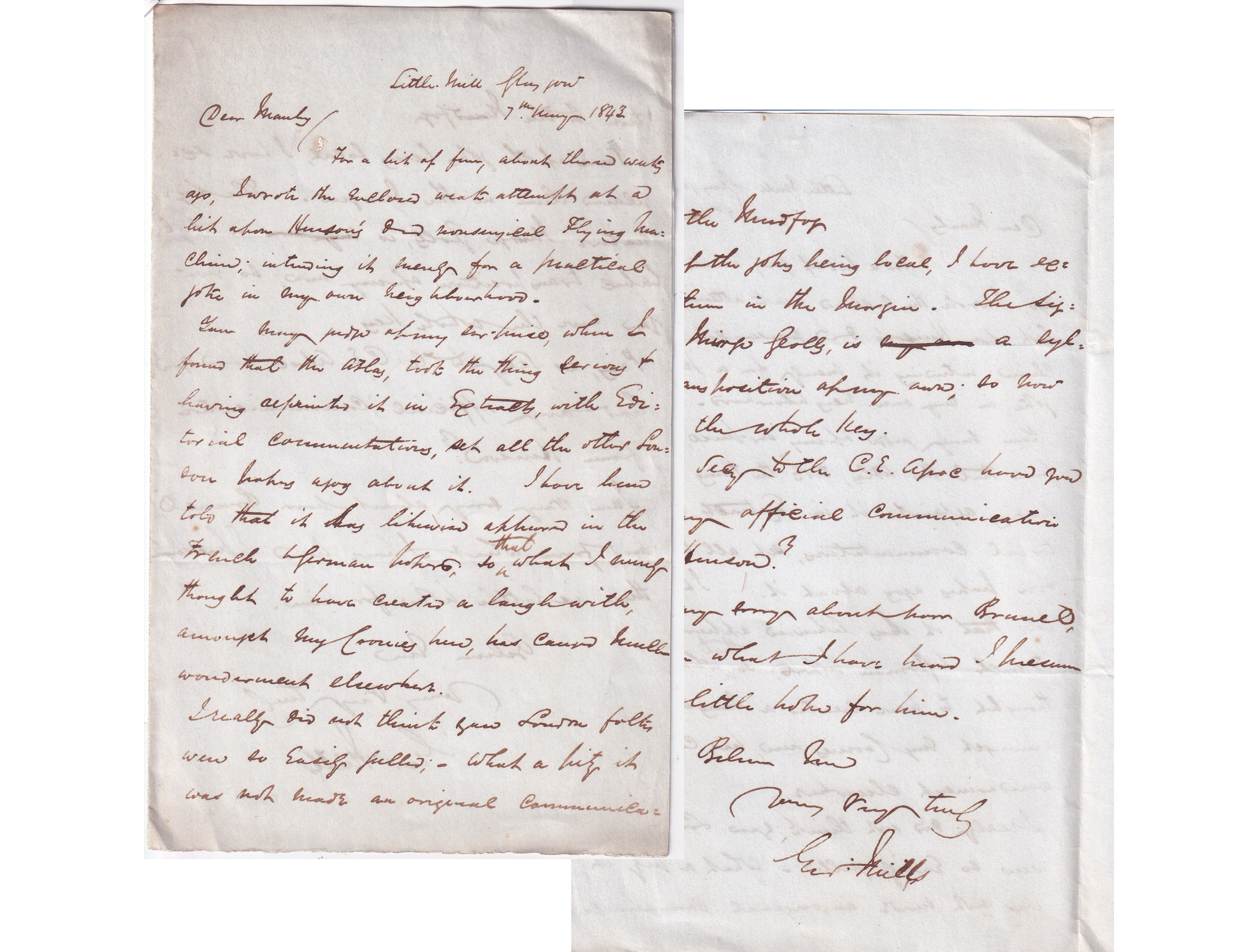
Remarkable 1843 autograph letter by Scottish shipbuilder, writer and later journalist George Mills (1808–1881), addressed to eminent civil engineer Charles Manby (1804–1884), then Secretary of the Institution of Civil Engineers, revealing Mills as the author of a successful newspaper hoax concerning William Samuel Henson’s pioneering Aerial Steam Carriage.
Dated Little Mill [Littlemills], Glasgow, 7 May 1843, the letter provides an extraordinary first-hand account of an aviation practical joke which escaped its intended local audience and was taken seriously by the London press.
Mills writes that approximately three weeks previously he had composed what he calls a:
“weak attempt at a hit about Henson’s … Flying Machine”
intending it:
“merely for a practical joke in my own neighbourhood.”
To Mills’s surprise, the London newspaper The Atlas treated the story seriously, reprinted it with editorial comment and, according to Mills, set the other London newspapers “agog”. Mills had additionally been told that the story had appeared in French and German newspapers.
The episode can now be identified with the extraordinary“Experimental Trip of the Aërial Machine”, published by The Atlas on 22 April 1843, concerning the fictitious Professor Geolls. The supposed experiment involved an aerial machine based upon William Samuel Henson’s design, launched from Dumbuck Hill near Glasgow before suffering mechanical failures and eventually plunging into the Firth, its fortunate inventor being rescued by a passing steamer. The story was subsequently reprinted by other newspapers and was exposed as a hoax by the Glasgow Constitutional.
The Aërial Adventure of Professor Geolls
See ‘The Aërial Adventure of Professor Geolls’ article on ‘New-Cleckit Dominie’ blog online. The press reaction continued immediately before this letter was written, with commentary appearing in the Kentish Mercury on 29 April, Hereford Journal on 3 May and Belfast News-Letter on 6 May 1843, the day before Mills dated this letter.
Mills explicitly discusses the assumed signature attached to his spoof, describing it as:
“a syllabic transposition of my own”
and adding:
“so now you have the whole key.”
The final element of the manuscript pseudonym can confidently be read as“Geolls” from its independently documented appearance in the published hoax; the short preceding word remains unidentified and is not forced here into a speculative reading.
Mills additionally remarks that some of the jokes were local, and that he had explained these in the margins of the enclosed piece.
The enclosure referred to by Mills is no longer present.
The background to the joke is particularly interesting. Henson and John Stringfellow’s proposed steam-powered flying machine was receiving enormous attention in the spring of 1843, and The Atlas itself had devoted extensive space to the invention in its issue of 1 April.
This makes Mills’s hoax extraordinarily contemporary: rather than being a later parody of an unsuccessful invention, it was written during the original publicity and debate surrounding one of the most celebrated early proposals for powered, fixed-wing flight.
The recipient, Charles Manby, was particularly appropriate. Manby served as Secretary of the Institution of Civil Engineers from 1839 and had substantial experience in iron and steam engineering, including involvement with the pioneering iron steamship Aaron Manby.
Mills accordingly asks:
“Pray, as Secy to the C.E. Assoc. have you had any official Communication from Henson?”
The letter therefore combines private humour with a serious enquiry as to whether Henson had made an official approach to the engineering establishment.
Important Brunel reference
The final paragraph contains another exceptional contemporary engineering reference:
“I am very sorry about poor Brunel, and from what I have heard I fear there is little hope for him.”
This almost certainly refers to Isambard Kingdom Brunel and the famous half-sovereign accident of spring 1843.
Brunel had accidentally inhaled a gold half-sovereign while performing a conjuring trick for his children, leaving the coin lodged in his airway. The incident and subsequent attempts to remove the coin became widely known.
When Mills wrote on 7 May 1843, the crisis remained unresolved. The coin was eventually dislodged on 16 May, nine days after this letter.
Thus the manuscript captures Mills’s genuine contemporary fear for Brunel while the outcome remained uncertain.
About George Mills
George Mills was a Scottish shipbuilder, journalist and novelist. From the 1830s he was involved in shipbuilding at Littlemills, Bowling-on-the-Clyde, where the firm built iron steamers and canal boats. He later became a journalist and literary critic and published several works of fiction.
His combination of practical steam-engineering knowledge, local Clyde geography and literary ability provides particularly appropriate background for the elaborate technical flying-machine spoof revealed in this letter.
Historical significance
A fascinating document combining several strands of early Victorian technological history:
- First-hand confession of authorship by George Mills of the 1843 flying-machine practical joke.
- Directly related to the contemporary excitement surrounding William Samuel Henson’s pioneering Aerial Steam Carriage.
- Connects the manuscript with the Professor Geolls aerial-machine hoax published by The Atlas, 22 April 1843.
- Mills describes the unexpected spread of the joke through the London press and reports hearing that it had reached French and German newspapers.
- Mills explains that the pseudonymous signature was a“syllabic transposition” of his own.
- Local jokes in the original enclosure were apparently annotated and explained by Mills.
- Written to Charles Manby, Secretary of the Institution of Civil Engineers.
- Asks whether Manby had received any official communication from Henson.
- Contains an important contemporary reference to“poor Brunel” during Isambard Kingdom Brunel’s unresolved 1843 half-sovereign crisis.
- The letter was written while the Professor Geolls affair was still actively circulating in the newspapers, rather than as a later recollection.
Of particular research interest, the surviving modern account of the Professor Geolls hoax reconstructs the newspaper episode but does not identify George Mills as its author. This manuscript therefore appears to provide important first-hand evidence identifying Mills as the writer behind the hoax.
Physical Description
Original autograph letter signed “Geo: Mills”, dated 7 May 1843.
Written in ink on thin, lightweight writing paper, somewhat reminiscent in weight of later airmail paper, resulting in considerable natural show-through of the manuscript from the opposite side.
The accompanying item referred to by Mills as “the enclosed” is no longer present.
An unusual and highly evocative survival from the very earliest period of serious public speculation about powered flight, combining aviation history, Victorian journalism, engineering, the Institution of Civil Engineers, Henson, Manby, Mills and Brunel in a single contemporary manuscript.
Provenance:
From a miscellaneous collection bought at auction. Guaranteed GENUINE.


George Mills (1808 – 1881) was a 19th-century Scottish shipbuilder, journalist and novelist.
Charles Manby (Feb 1804 – Jul 1884) was Secretary of the Institution of Civil Engineers from November 1839 to 1856, and engineer of the first iron steamer to cross the English Channel. Fluent in French, he installed gas piping into Paris and advised on the construction of the Suez Canal.
William Samuel Henson (May 1812 – Mar 1888) was a British-born pre-Wright brothers aviation pioneer, engineer and inventor. He is best known for his work on the aerial steam carriage alongside John Stringfellow. The aerial steam carriage, also named Ariel, was a flying machine patented in England in 1842 that was supposed to carry passengers into the air. It was, in practice, incapable of flight since it had insufficient power from its heavy steam engine to fly. A more successful model was built in 1848 which was able to fly for small distances within a hangar. The aerial steam carriage was significant because it was a transition from glider experimentation to powered flight experimentation.
Isambard Kingdom Brunel (Apr 1806 – Sep 1859) was an English civil and marine engineer considered “one of the greatest figures of the Industrial Revolution”, “perhaps the most eminent Victorian engineer”, and one whose work “altered the lives of almost every person in Britain, and millions abroad”. The first engineer of the Great Western Railway (GWR), he was responsible for the design and construction of its London–Bristol main line. His maritime career saw the construction of the largest steamships in the world at the time, the SS Great Western, SS Great Britain, and SS Great Eastern. His career was marred by continual financial and engineering setbacks.
Leave a Reply