
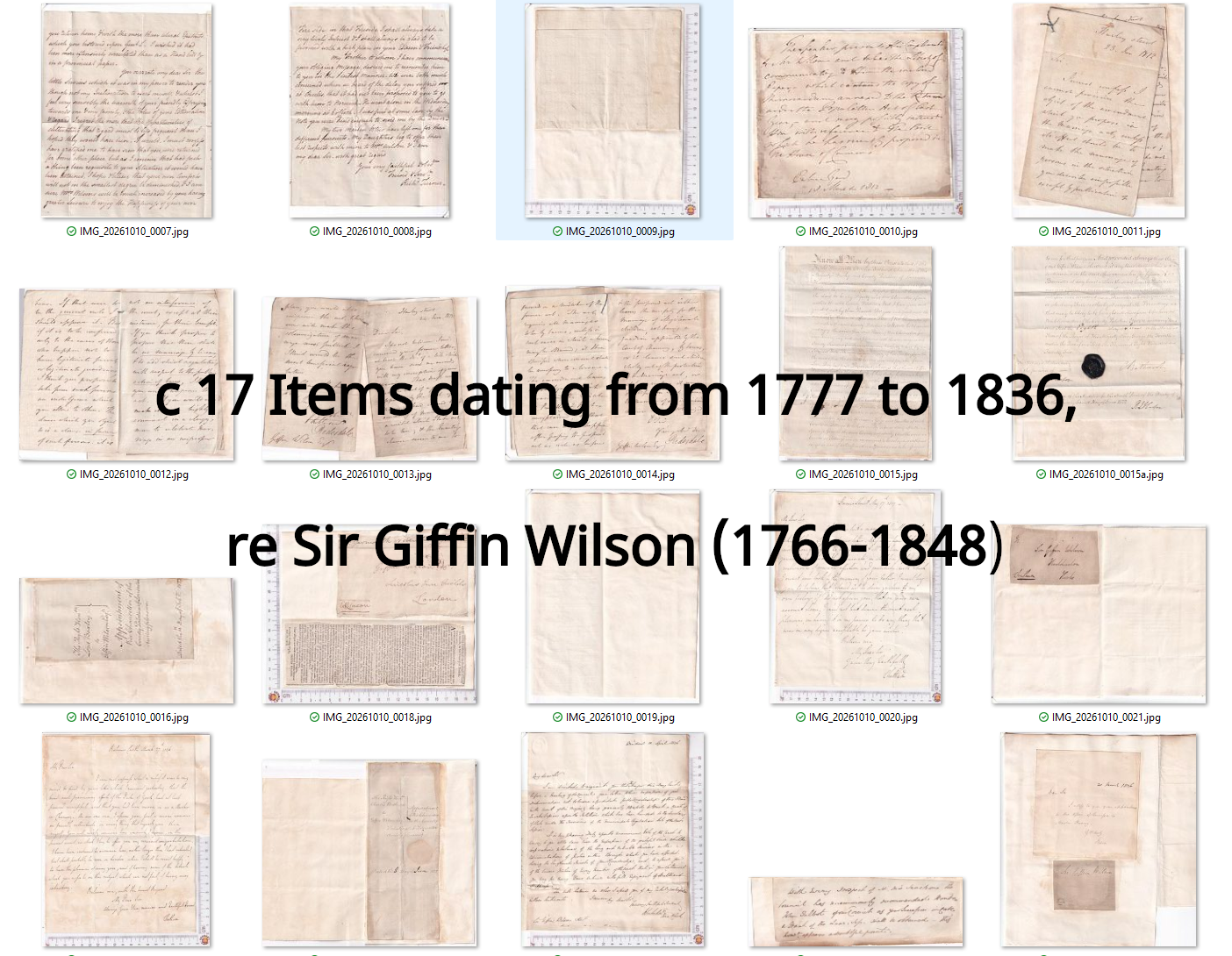
Important archive of approximately 18 manuscript, autograph, legal and political items relating to Sir Giffin Wilson (1766-1848), barrister, King’s Counsel, Member of Parliament for Great Yarmouth, Vice-Chancellor of the County Palatine of Lancaster, Master in Chancery, and Recorder of Windsor, spanning the period 1777-1836.
Unlike many autograph accumulations, this archive forms a remarkably cohesive documentary record of a significant legal and political career, preserving original correspondence, judicial appointments, parliamentary material, election, autograph franks, official commissions, legal memoranda, and Chancery reform papers across almost sixty years.
The collection provides an exceptional insight into the workings of high office, parliamentary politics, judicial patronage, legal reform and public service during the Georgian, Regency and early Victorian periods.
Archive comprises approximately 18 items including:
- 1777 autograph letter signed by Thomas Cholmondeley of Vale Royal, discussing education, morality, Christianity, Lord Chesterfield and the upbringing of young gentlemen.
- Two 1812 legal reform letters from Lord Redesdale, containing detailed commentary on proposed amendments to the Marriage Act.
- 1812 letter from Charles Abbot, Speaker of the House of Commons, forwarding information relevant to legislation being promoted by Wilson.
- Great Yarmouth parliamentary election material including Wilson’s printed address to the electors following his defeat in 1812.
- 1812 letter from Rev. Richard Turner discussing the election and its aftermath.
- Cover franked by E. K. Lacon, connected with the Great Yarmouth election correspondence.
- 1807 letter from John Pitt, 2nd Earl of Chatham, referring warmly to the memory of Wilson’s father, Rev. Edward Wilson, tutor to William Pitt the Younger.
- Official commission of 1822 signed by Charles Bathurst, appointing Wilson Vice-Chancellor of the County Palatine of Lancaster.
- Official commission of 1823 signed by Lord Bexley, recommissioning Wilson as Vice-Chancellor.
- 1824 Duchy of Lancaster letter regarding the adjournment of Chancery sittings.
- 1826 appointment notification signed by Lord Eldon, informing Wilson of his appointment as successor to Master Harvey and thus to the office of Master in Chancery.
- Important 1826 letter from the 2nd Earl of Chatham congratulating Wilson and explicitly referring to the successful intervention of the Duke of York in securing the appointment.
- 1834 memorial submitted by Sir Giffin Wilson to the Lords Commissioners of the Treasury seeking compensation after reforms reduced the income attached to the office of Master in Chancery by approximately £1,000 per annum.
- Address panel franked by Earl of Ellenborough.
- 1836 Windsor Corporation letter acknowledging Wilson’s long service as Recorder of Windsor.
- Associated note concerning the proposed succession of John Talbot.
- Additional related covers, dockets and appointment papers retained within the archive.
Historical Importance
The archive traces Sir Giffin Wilson’s career from the world of the late Georgian political elite through parliamentary service, legal reform, judicial promotion and eventual retirement. Particularly noteworthy is the sequence documenting his advancement to Master in Chancery in 1826.
Taken together, the papers provide a rare and unusually complete record of nineteenth-century judicial patronage. The archive preserves:
- The official appointment notification from Lord Eldon.
- Private correspondence revealing that the Duke of York actively supported Wilson’s promotion.
- Official Duchy of Lancaster commissions.
- Parliamentary and election material.
- Wilson’s own memorial seeking compensation after Chancery reforms.
The result is a coherent working archive rather than a simple collection of autograph signatures.
Areas of Interest
- Legal History
- Chancery
- Judicial Reform
- Parliamentary History
- Electoral History
- Great Yarmouth
- Duchy of Lancaster
- Windsor History
- Regency Politics
- Georgian Politics
- Government Patronage
- William Pitt Circle
- Marriage Act Reform
- British Judiciary
A substantial and research-worthy archive documenting the life and career of one of the most significant legal figures represented in nineteenth-century manuscript material.
Approximately 18 items preserved on a group of original nineteenth-century album pages. Letters, free fronts, autograph franks, official commissions, dockets and related papers are mounted in the manner of a contemporary collector’s archive. The material appears to have remained together since its incorporation into the album and now forms a coherent archive documenting the life and career of Sir Giffin Wilson between 1777 and 1836.
Provenance:
One of c.2,500+ items once from the collection or dealer stock of Winifred A Myers (Autographs) Ltd, St Martins Lane, London, evidenced by the quantity of Myers pre-printed envelopes and paper folders and the general ‘presentation’ of the items, many having Myers identification notes in pencil.
Winifred Alice Myers (1909 – 1985) served as ABA (Antiquarian Booksellers Assoc) president, 1950-1952. See the ABA website for an extended article on Myers. Myers left her business, in 1985, to Ruth Shepherd, who traded from home until 2004.


Sir Giffin Wilson (1766 – Aug 1848) was an English barrister, judge and politician. He was the eldest son of Edward Wilson, rector of Binfield, Berkshire and tutor of William Pitt the Younger, and entered Lincoln’s Inn in 1782, was called to the bar in 1789, and became a commissioner of bankrupts in 1793. He was elected a Fellow of the Royal Society in 1801. He succeeded his father in 1804. Wilson became in 1808 a Member of Parliament for Great Yarmouth as a government supporter. He was defeated there in 1812, his patron Harbord Harbord, 1st Baron Suffield having died. He later become vice-chancellor of the County Palatine of Lancaster, and then vice-chancellor of Chester. He continued his career as a Master in Chancery and was knighted in 1823.
Leave a Reply