
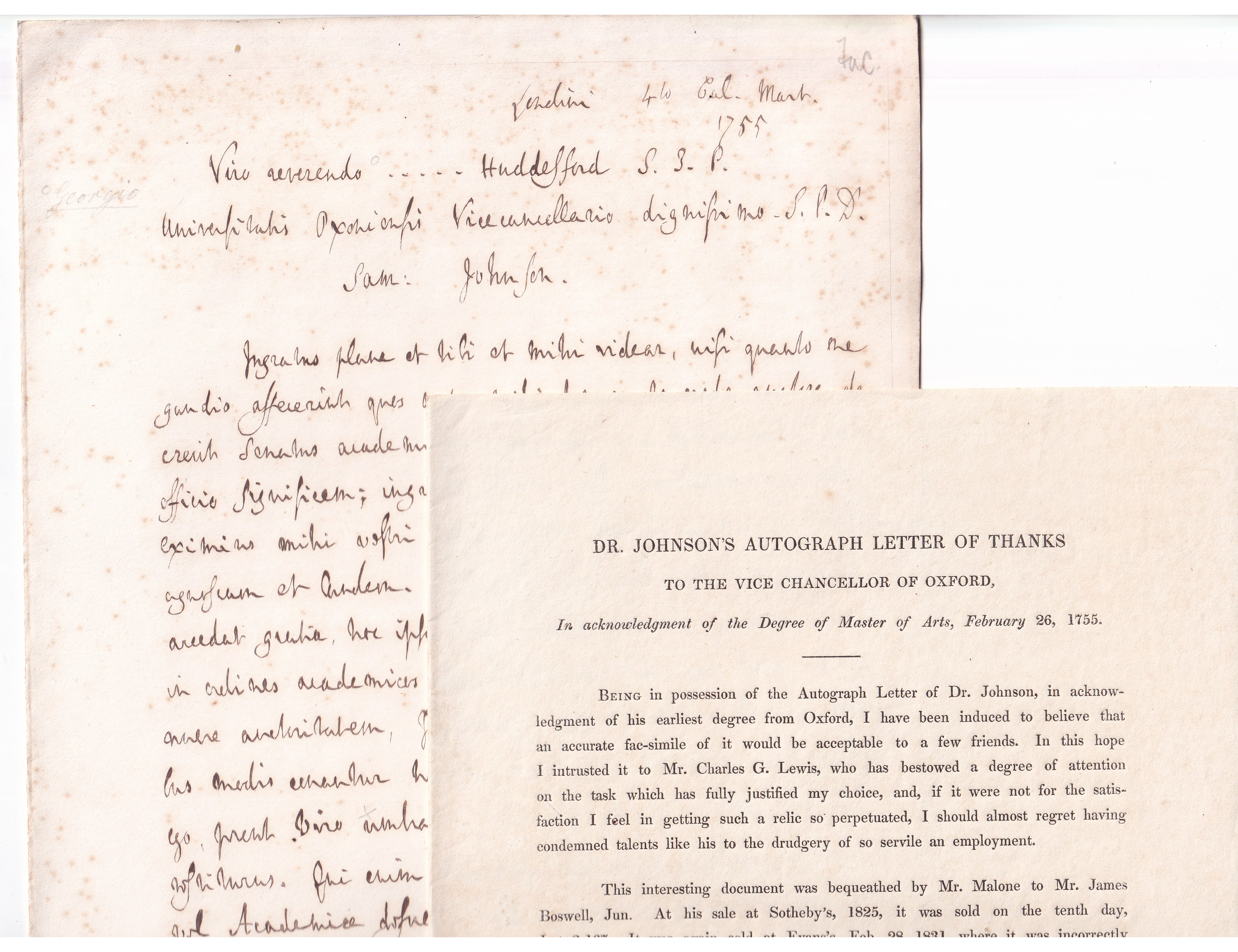
A fascinating and apparently very scarce two-part publication relating to Samuel Johnson’s celebrated letter of thanks to George Huddesford, Vice-Chancellor of Oxford, on the occasion of Johnson’s receipt of the honorary degree of Master of Arts in February 1755.
The lot comprises:
1. Explanatory pamphlet (4 pages)
Entitled:
Dr. Johnson’s Autograph Letter of Thanks to the Vice Chancellor of Oxford, in acknowledgment of the Degree of Master of Arts, February 26, 1755.
Dated:
The Sanctuary, Westminster, July 15, 1831.
In this pamphlet Henry Smedley explains that he had acquired the original Johnson manuscript and commissioned an accurate facsimile from the noted engraver Charles George Lewis. Smedley further records the provenance of the original letter, stating that it had descended from Edmond Malone to James Boswell Jr. before its subsequent sale and acquisition by Smedley.
The pamphlet is signed in print “H. S.”; a contemporary hand has completed this to “Hy Smedley”, “Hy” being a common nineteenth-century abbreviation for Henry.
2. Separate facsimile letter (4 pages)
Printed on heavy paper and reproducing Johnson’s original Latin letter dated:
Londini, 4to Cal. Mart. 1755
together with the exterior address panel:
To the Revd Dr Huddesford
The final page features an embossed address panel reproducing the appearance of the original folded letter. Internal pages blank as issued.
Historical Background
The original letter was written by Samuel Johnson on 26 February 1755 to thank Oxford University for conferring upon him the honorary degree of Master of Arts, awarded shortly before publication of his monumental Dictionary of the English Language.
The letter was written in Latin, the customary language for formal academic communications at Oxford during the eighteenth century. Johnson, a distinguished classical scholar as well as lexicographer, composed a polished and elegant letter acknowledging the honour.
Beyond a simple expression of thanks, the text also supports Vice-Chancellor George Huddesford during contemporary Oxford controversies, referring to opponents as:
homines vafri nec tamen acuti
(“cunning though not truly clever men”)
and describing himself as:
viro umbratico
or a retired scholar, a reading specifically discussed by Smedley in the accompanying pamphlet.
Provenance & Significance
This publication is far more than a simple autograph facsimile.
The accompanying pamphlet records the ownership history of the original manuscript through the collections of Edmond Malone and James Boswell Jr., two of the most important figures associated with Johnson scholarship and biography, before its acquisition by Henry Smedley in 1831.
Smedley states that the facsimile was prepared from the original manuscript then in his possession and intended for circulation amongst “a few friends”, suggesting a private rather than commercial issue.
Rarity
Extensive searches of major online institutional catalogues, digitised collections, auction archives and antiquarian bookseller records have been undertaken. No other complete example comprising both the explanatory pamphlet and separately-issued facsimile letter has been traced. While this does not prove uniqueness, surviving complete sets appear to be scarce.
An attractive and unusual piece of Johnsoniana combining literary history, Oxford University history, Boswell and Malone provenance, early nineteenth-century facsimile production and antiquarian collecting history.
Provenance:
One of c.2,500+ items once from the collection or dealer stock of Winifred A Myers (Autographs) Ltd, St Martins Lane, London, evidenced by the quantity of Myers pre-printed envelopes and paper folders and the general ‘presentation’ of the items, many having Myers identification notes in pencil.
Winifred Alice Myers (1909 – 1985) served as ABA (Antiquarian Booksellers Assoc) president, 1950-1952. See the ABA website for an extended article on Myers. Myers left her business, in 1985, to Ruth Shepherd, who traded from home until 2004.


Samuel Johnson (Sep 1709 – Dec 1784), often called Dr Johnson, was an English writer and polymath who made lasting contributions as a poet, playwright, essayist, moralist, literary critic, sermonist, biographer, editor, and lexicographer (creator of dictionaries). The work for which he is best known is his 42,733-entry Dictionary of the English Language (1755). For this and other contributions in and to the English language, the Oxford Dictionary of National Biography has called him “arguably the most distinguished man of letters in English history”.
Leave a Reply