
Exeter City Asylum, 1897-1899
I entered service at Exeter City Asylum, Digby, near Exeter, on 10 April 1897.
During my training I worked in the infirmary and private wards, eventually becoming Second Charge Nurse. While at Exeter I studied for the St John Ambulance First Aid Certificate and the Medico-Psychological Association Certificate of Proficiency in Mental Nursing.
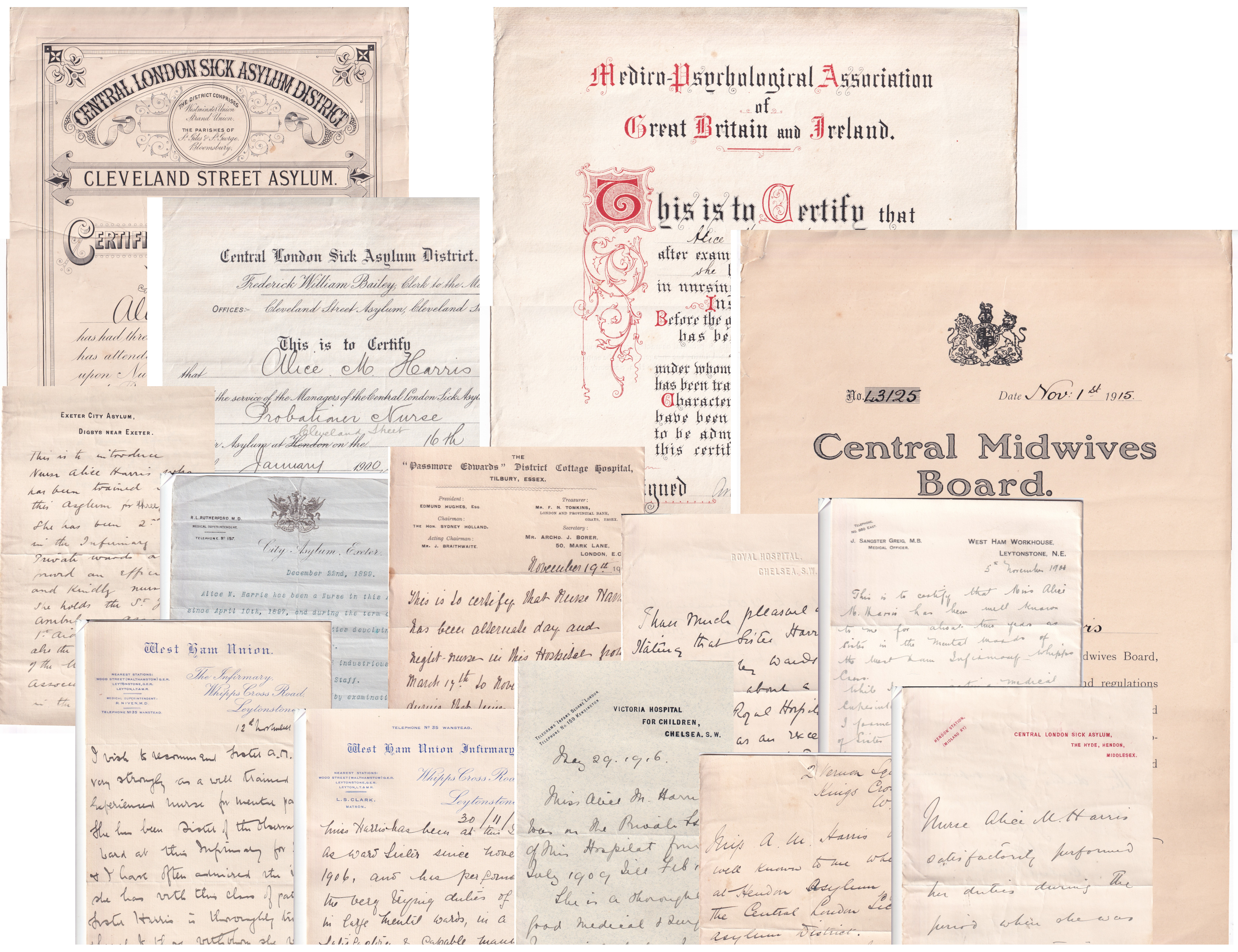
On 24 May 1899, I was awarded the Medico-Psychological Association certificate after examination by senior members of Britain’s principal psychiatric organisation.
As I prepared to leave Exeter, L. Harris-Liston MRCS LRCP LSA, Medical Officer at Exeter City Asylum, wrote in December 1899 that I had trained in the institution for three years, had served as Second Charge Nurse and had proved “an efficient and kindly nurse.” He also recorded that I had passed the Association’s examination “most creditably.”
A second testimonial followed on 22 December 1899 from Dr R. L. Rutherford, Medical Superintendent of Exeter City Asylum. Dr Rutherford noted that I had served since April 1897 and described me as:
“kind-hearted, civil and industrious”
adding that I was popular with both patients and staff.
Training in London, 1900-1903
On 16 January 1900 I entered the service of the Central London Sick Asylum District as a Probationer Nurse.
For three years I trained at Cleveland Street Asylum, undertaking lectures, demonstrations, written examinations and practical nursing work.
My training concluded on 16 January 1903, when I was awarded the institution’s Certificate of Trained Nurse.
A service certificate issued shortly before my departure recorded:
Discharge of Duties: Satisfactory
General Conduct: Good
and noted that I was leaving by voluntary resignation.
Passmore Edwards Cottage Hospital, Tilbury, 1903
My next appointment was at the Passmore Edwards District Cottage Hospital, Tilbury.
Matron Caroline Myra Watson recorded on 19 November 1903 that I had worked as alternate day and night nurse from March to November of that year and that my work had been satisfactory throughout.
Mental Wards at West Ham Infirmary, 1903-1908
By 1904 I was serving as Sister in the Mental Wards of West Ham Infirmary at Whipps Cross.
On 5 November 1904, Dr J. Sangster Greig, formerly Acting Medical Superintendent of the institution, wrote that I was:
“thoroughly well trained in mental nursing”
and further stated that he held a very high opinion of my professional knowledge and management of the wards.
From 1906 to 1908 I continued at Whipps Cross, eventually becoming Sister of the Observation Ward.
On 12 November 1908, the Acting Medical Superintendent wrote:
“I have often admired the influence she has with this class of patient.”
The reference continued by describing me as a well-trained and experienced nurse for mental patients, careful and considerate of their welfare.
A further testimonial was written on 30 November 1908 by Letitia S. Clark, Matron of West Ham Union Infirmary.
Clark wrote that I had performed the “very trying duties” of Sister in large mental wards in a highly satisfactory and capable manner, adding that she was sorry to lose my services from work “for which she is so well adapted.”
These references form the strongest evidence that a significant part of my career was spent specialising in psychiatric nursing.
Private Nursing and Chelsea, 1904-1906
Alongside institutional appointments, I also undertook private nursing work.
A testimonial dated 12 March 1906 was written by C. Molesworth Tuke of Chiswick House, recording that I had been employed there for twelve months between May 1904 and May 1905 and had given every satisfaction.
Another testimonial followed from the Royal Hospital, Chelsea, on 18 July 1906.
Written by Lieutenant-Colonel R. W. Ford, RAMC, the reference describes me as:
“an excellent nurse”
who was capable, patient and thoroughly reliable.
Ford added that he would gladly recommend me for any position involving trust and responsibility.
Victoria Hospital for Children, 1909-1916
In July 1909 I joined the private staff of the Victoria Hospital for Children, Chelsea.
This appointment broadened my experience beyond mental nursing into medical and surgical nursing for children.
When my service ended in February 1916, Jane Watson, Lady Superintendent of the hospital, wrote on 29 May 1916 that I was:
“a thoroughly good medical & surgical nurse”
and that I had given “entire satisfaction” throughout my years of service.
Qualification as a Midwife, 1915
While serving at Victoria Hospital I continued to add to my professional qualifications.
On 1 November 1915, during the First World War, I received Central Midwives Board Certificate No. 43125 under the provisions of the Midwives Act 1902.
The certificate entitled me by law to practise as a certified midwife.
A Career in Nursing
The surviving archive documents a professional career spanning almost twenty years.
Between 1897 and 1916 I served at:
- Exeter City Asylum
- Cleveland Street Asylum
- Passmore Edwards Cottage Hospital, Tilbury
- West Ham Infirmary, Whipps Cross
- Chiswick House
- Royal Hospital Chelsea
- Victoria Hospital for Children, Chelsea
The papers record a progression through psychiatric nursing, general nursing, children’s nursing and midwifery, providing an unusually complete picture of the working life of a professional nurse during the late Victorian, Edwardian and First World War periods.


James Beveridge Spence (1852-1914)
Registrar of the Medico-Psychological Association when Harris received her psychiatric nursing certificate on 24 May 1899, and President of the Association shortly afterwards (1899-1900). One of the leading asylum physicians of his generation, Spence is arguably the most senior psychiatric figure represented in the archive.
A. R. Urquhart (1840s-1900s)
President of the Medico-Psychological Association in 1898-99 and Superintendent of James Murray’s Royal Asylum, Perth. His signature on Harris’s 1899 certificate places her qualification directly under the authority of one of Britain’s foremost psychiatrists.
Robert Leonard Rutherford
Medical Superintendent of Exeter City Asylum and Harris’s principal trainer between 1897 and 1899. His certificate signature and detailed reference of 22 December 1899 document the beginning of her career and her qualification in mental nursing.
C. Molesworth Tuke (1857-1925)
Signer of the 12 March 1906 reference relating to Harris’s service at Chiswick House. A member of the famous Tuke family associated with the York Retreat and the development of humane psychiatric care. Probably the most recognisable surname in British mental-health history represented in the archive.
Exeter City Asylum, Digby, Exeter
Opened in 1886, Exeter City Asylum was a large municipal psychiatric institution. It was here that Alice Harris began her nursing career in 1897, trained in mental nursing, gained her Medico-Psychological Association qualification, and rose to become Second Charge Nurse.
Cleveland Street Asylum, London
Part of the Central London Sick Asylum District, Cleveland Street was an important training institution for nurses serving the sick poor of central London. Harris trained here from 1900 to 1903 and qualified as a trained nurse.
Passmore Edwards District Cottage Hospital, Tilbury
A small general hospital founded through the philanthropy of John Passmore Edwards. Harris worked here in 1903, gaining valuable experience in general hospital nursing after completing her formal training.
West Ham Infirmary, Whipps Cross
One of the largest Poor Law infirmaries in Britain, with substantial mental wards and observation facilities. Harris served as Sister in the Mental Wards and later Sister of the Observation Ward, receiving some of her strongest testimonials for work with psychiatric patients.
Chiswick House
A private nursing appointment rather than a hospital post. The reference was written by C. Molesworth Tuke, a member of the influential Tuke family associated with the York Retreat and the reform of psychiatric care in Britain.
Royal Hospital Chelsea
The famous home of the Chelsea Pensioners. Harris served in the wards there and received a strong testimonial from a Royal Army Medical Corps officer praising her reliability and professional ability.
Victoria Hospital for Children, Chelsea
A specialist children’s hospital where Harris served from 1909 to 1916. Here she broadened her experience beyond psychiatric care, working as a medical and surgical nurse before qualifying as a midwife in 1915.
Medico-Psychological Association
The principal professional body for psychiatry and mental nursing in Britain, later evolving into the Royal College of Psychiatrists. Harris’s 1899 certificate places her among the early generation of formally qualified psychiatric nurses.
.
Leave a Reply