
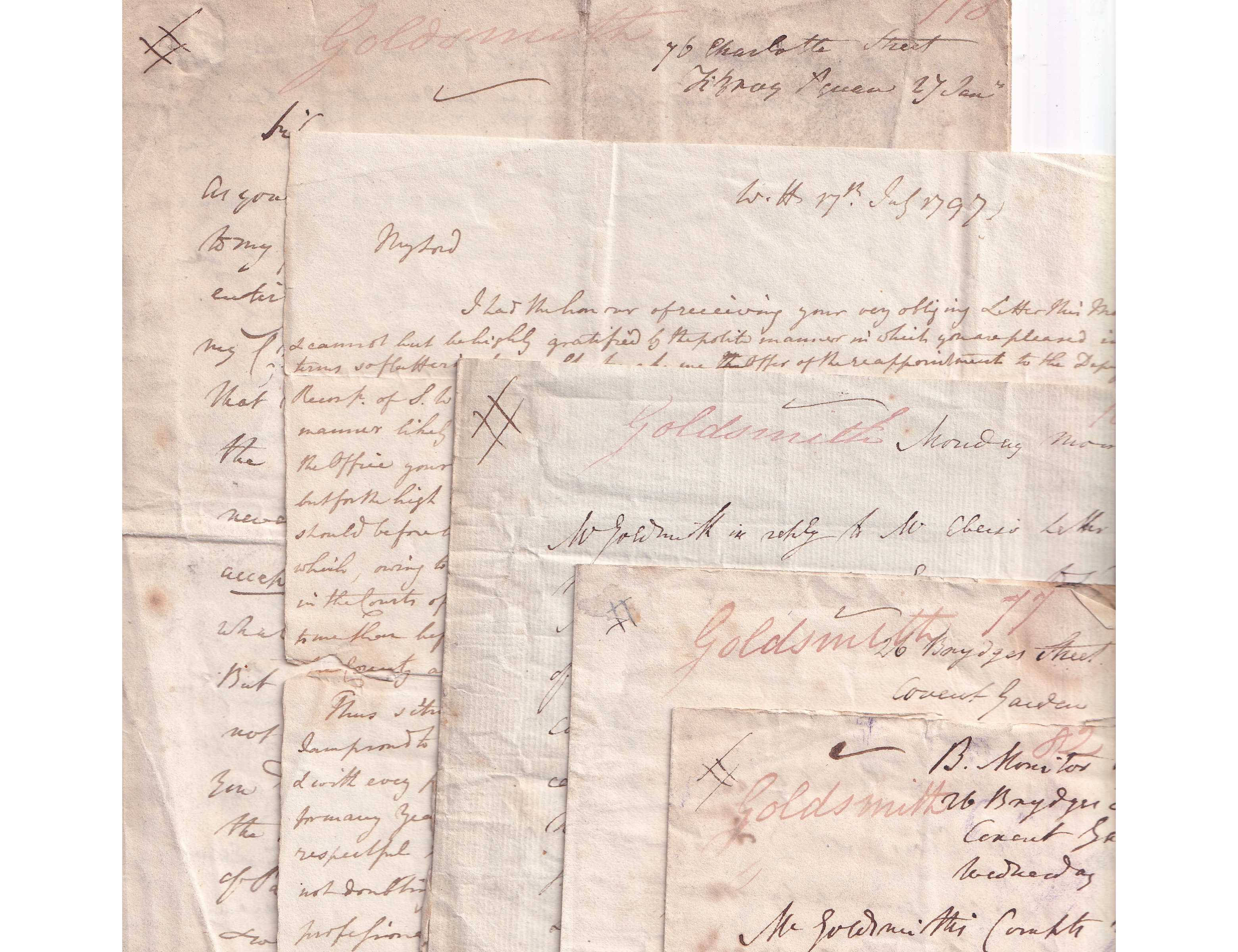
A remarkable archive of four autograph letters signed (ALS) by Lewis Goldsmith (c.1763-1846), controversial political journalist, editor of the British Monitor, and political author, addressed to John Ebers (1778-1858), celebrated manager of London’s King’s Theatre, Haymarket.
Written during January 1822, the letters document an extended and increasingly heated dispute concerning Goldsmith’s customary“Opera Bone”, a term repeatedly used throughout the correspondence.
Far from an ordinary ticket, the Opera Bone was a reusable and transferable theatre admission token, distinct from a personal place on the theatre’s free list. Goldsmith complains that a free-list admission was of little use because he could not send another person in his place when absent or ill, whereas the Opera Bone appears to have carried broader privileges. Surviving examples of theatrical admission checks of the period, made from bone, ivory and other materials, are now preserved in museum collections and illustrate the type of object being discussed. Charles Dickens Museum London notes that such reusable theatre admission checks were used by London playhouses and opera houses.
The correspondence develops from a polite enquiry regarding a missing Opera Bone into a detailed defence of Goldsmith’s social standing, readership, and influence. Throughout the letters he insists that the actual cost of admission is irrelevant; his concern is that he has been denied a privilege customarily granted to newspaper proprietors and editors.
Historically, the archive provides an excellent insight into:
- The relationship between London’s newspapers and theatre management.
- Regency theatre admission practices.
- The use of transferable “Opera Bones” and theatre admission checks.
- Professional privileges extended to newspaper editors.
- The aftermath of the Queen Caroline affair.
- The social importance attached to rank, influence and public reputation in Regency London.
Particularly revealing is Goldsmith’s lengthy defence of his newspaper’s readership. While conceding that rival publications may have enjoyed greater circulation, he argues that his readership consisted of influential political gentlemen and opera-goers. In one memorable passage he observes:
“a Cheesemonger has more Customers than a Jeweller”
The final letter is exceptionally rich in content. Goldsmith discusses hostility arising from the Queen’s Trial, refers repeatedly to Lord Lowther, defends the political principles of his newspaper, discusses circulation and readership, and attempts to discover why his customary privilege had been withdrawn.
One intriguing aspect of the correspondence is Goldsmith’s suspicion that political hostility may have contributed to the affair. Although the letters do not prove that Ebers acted from political motives, Goldsmith clearly wonders whether his newspaper’s unpopular stance during the Queen Caroline controversy had influenced attitudes towards him.
The archive therefore offers much more than autograph interest alone. It provides a vivid account of newspaper influence, theatre culture, political divisions, and personal status in Regency Britain.
A fascinating and substantial Regency correspondence archive between two notable figures of London’s political, journalistic and theatrical worlds.
Provenance:
One of c.2,500+ items once from the collection or dealer stock of Winifred A Myers (Autographs) Ltd, St Martins Lane, London, evidenced by the quantity of Myers pre-printed envelopes and paper folders and the general ‘presentation’ of the items, many having Myers identification notes in pencil.
Winifred Alice Myers (1909 – 1985) served as ABA (Antiquarian Booksellers Assoc) president, 1950-1952. See the ABA website for an extended article on Myers. Myers left her business, in 1985, to Ruth Shepherd, who traded from home until 2004.


Lewis Goldsmith (c 1763 – Jan 1846) was an Anglo-French publicist.
John Ebers (baptised 1778 – Dec 1858) was an English operatic manager, notable for his promotion of Italian opera in London in the 1820s.
Leave a Reply