
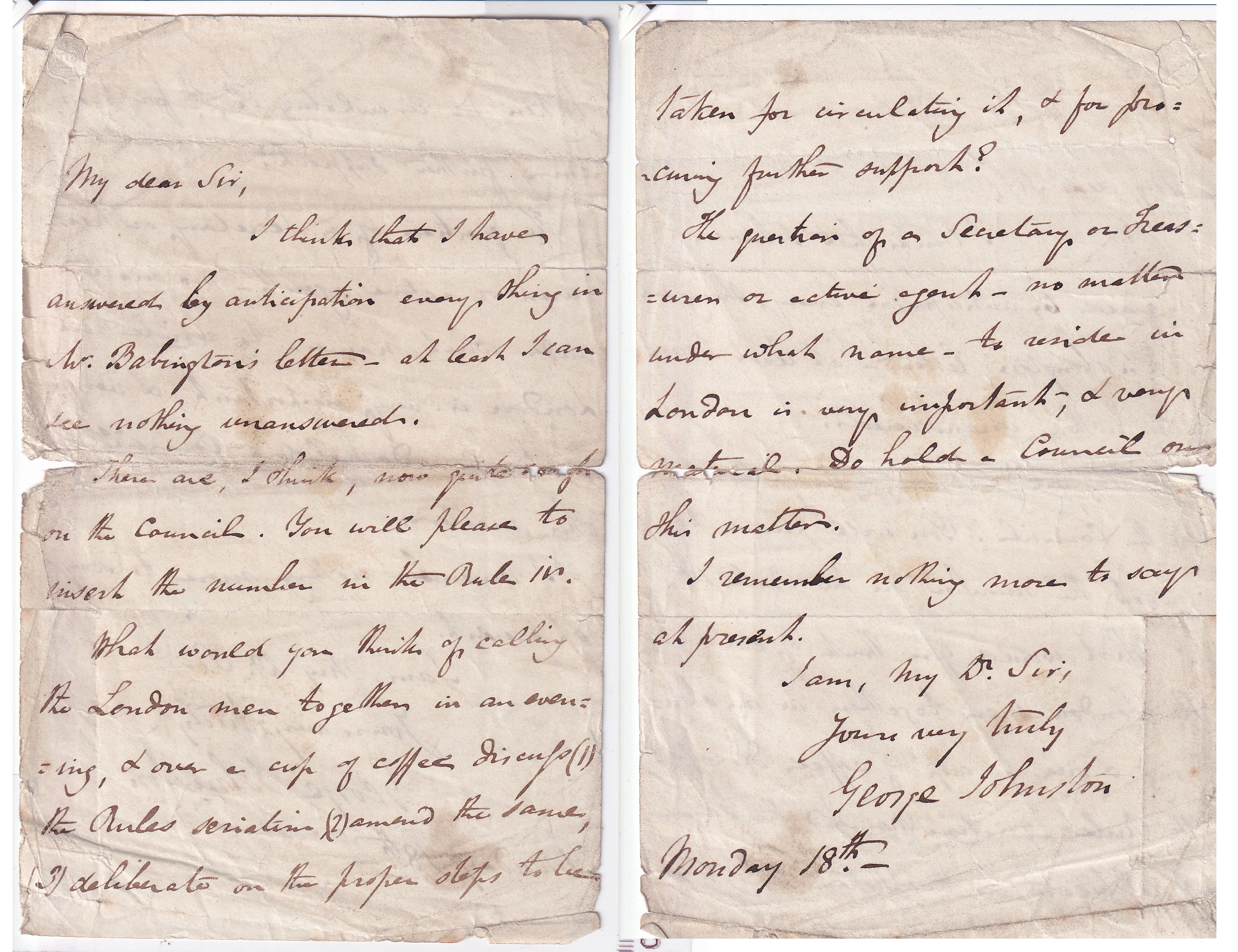
A highly important Autograph Letter Signed by George Johnston (1797-1855), Scottish naturalist, physician, founder of the Ray Society, and one of the most influential figures in Victorian natural history. The letter dates from the crucial formative period immediately preceding the establishment of the Ray Society and discusses the practical organisation of the new body.
Addressed to a fellow organiser, Johnston refers to a letter received from the botanist Cardale Babington (1808-1895) and discusses outstanding matters relating to the proposed Society’s constitution and management. Among the topics are the size of the Council, amendments to the Rules, the circulation of the Society’s prospectus, the recruitment of further support, and the appointment of a London-based secretary, treasurer or active agent.
The letter contains the significant passage:
“There are, I think, now quite enough on the Council. You will please to insert the number in the Rule iv.”
This almost certainly relates to the drafting of the Society’s constitution. Contemporary accounts of the Society’s foundation record Johnston’s discussions with Babington in December 1843 concerning the proposed Council and governance of the new organisation. Johnston initially envisaged a Council of around fourteen members before the final enlarged body was elected.
Particularly notable is Johnston’s suggestion that the:
“London men”
should be gathered together to review the rules, amend them, and consider the best means of circulating the scheme and obtaining additional support. The phrase closely echoes Johnston’s known correspondence concerning management of the nascent Ray Society, where he acknowledged that much of its administration would necessarily rest with the London membership.
The historical context is unusually strong. In late 1843 Johnston was seeking support for a new subscription publishing society dedicated to issuing significant works on natural history which commercial publishers were unwilling to undertake. A prospectus was circulated shortly before Christmas 1843, with Cardale Babington responsible for canvassing support in Cambridge while other prominent naturalists recruited members elsewhere. The Society was formally inaugurated on 2 February 1844.
Research strongly suggests this letter dates to Monday, 18 December 1843, only weeks before the formal establishment of the Ray Society. It therefore represents genuine foundation correspondence relating directly to one of the most important natural history publishing societies of the nineteenth century. Johnston’s initiative ultimately transformed the publication of zoological and botanical scholarship and the Society remains active today.
An exceptional piece of Victorian scientific history linking two important naturalists and documenting the creation of the Ray Society during its earliest and most formative weeks.
Provenance:
One of c.2,500+ items once from the collection or dealer stock of Winifred A Myers (Autographs) Ltd, St Martins Lane, London, evidenced by the quantity of Myers pre-printed envelopes and paper folders and the general ‘presentation’ of the items, many having Myers identification notes in pencil.
Winifred Alice Myers (1909 – 1985) served as ABA (Antiquarian Booksellers Assoc) president, 1950-1952. See the ABA website for an extended article on Myers. Myers left her business, in 1985, to Ruth Shepherd, who traded from home until 2004.


George Johnston (1797 – 1855) was a Scottish physician and naturalist. Johnston was one of the founders of the Ray Society & Berwickshire Naturalists’ Club and became its first president. His books include The Flora of Berwick-upon-Tweed, History of British Zoophytes, and History of British Sponges and Lithophytes.
Charles Cardale Babington (Nov 1808 – Jul 1895) was an English botanist, entomologist, and archaeologist. He was elected a Fellow of the Royal Society in 1851. A contemporary of Charles Darwin, he was a student of John Stevens Henslow, active in botanical circles and succeeded Henslow as professor of botany at Cambridge. Apart from the Manual of British Botany which went into several editions, he published floras of Bath and Cambridgeshire; and a monograph on the genus Rubus. In his taxonomic approach, he was considered a splitter.
Leave a Reply