
Among the great scientific names of Victorian Britain, few are more instantly recognisable than Thomas Henry Huxley (1825-1895), the formidable biologist, educator and public intellectual remembered to history as “Darwin’s Bulldog”.
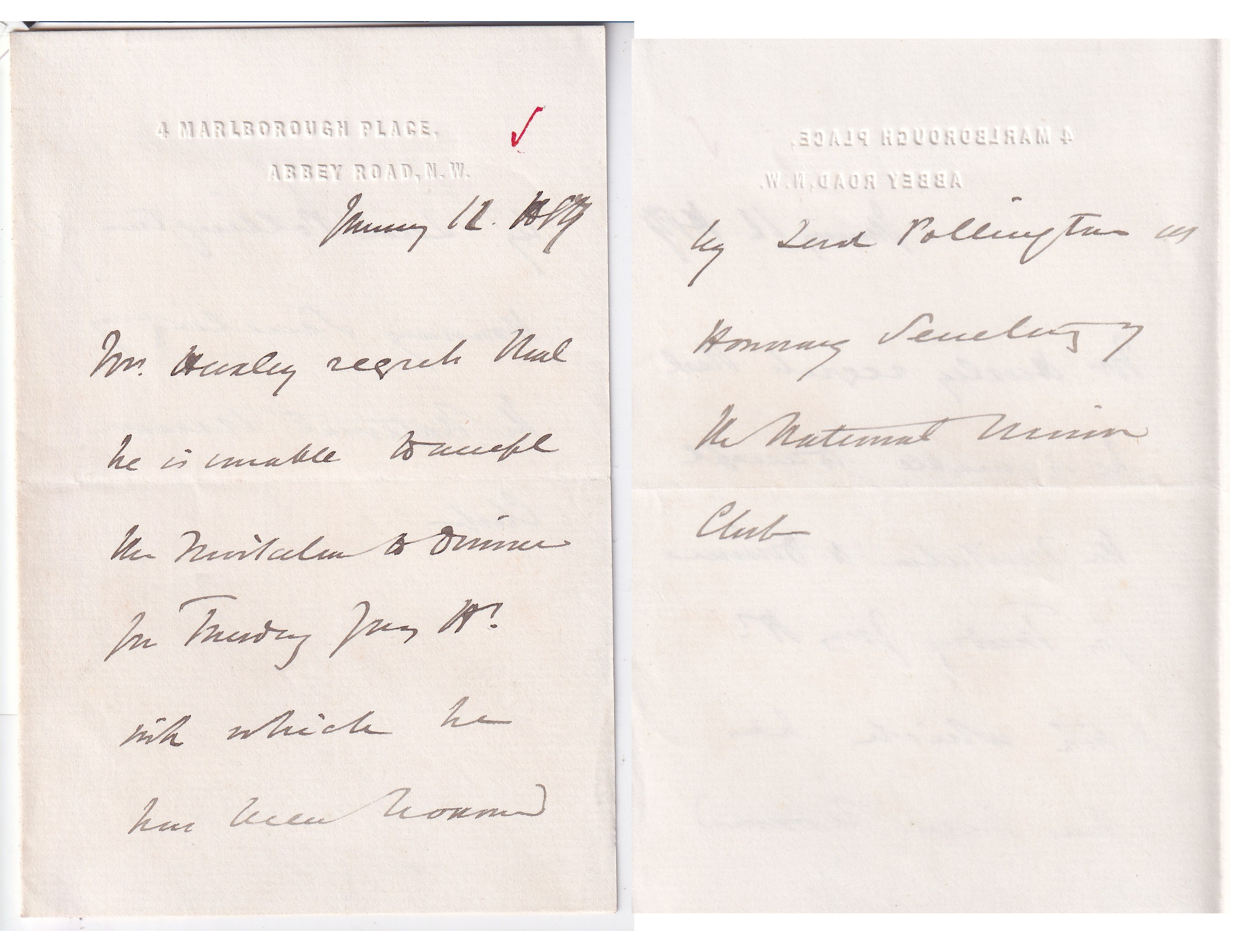
The present autograph note, written from 4 Marlborough Place, Abbey Road, N.W. on 12 January 1879, offers a small but revealing glimpse into Huxley’s position within the intellectual and social elite of late Victorian Britain.
The brief message reads:
“Mr. Huxley regrets that he is unable to accept the invitation to dinner for Tuesday Jany 14th. with which he has been honoured by Lord Pollington as Honorary Secretary the National Union Club.”
At first glance, this appears to be nothing more than a routine social refusal. In reality, it illustrates just how prominent Huxley had become by the late 1870s.
Who Was “Darwin’s Bulldog”?
Born in 1825, Huxley rose from relatively modest beginnings to become one of the most influential scientific figures of the nineteenth century. Although Charles Darwin originated the theory of evolution by natural selection, it was often Huxley who defended evolutionary ideas in public debate and before wider audiences. His vigorous advocacy earned him the enduring nickname “Darwin’s Bulldog”.
Huxley was not merely a supporter of Darwin. He was a distinguished scientist in his own right, making important contributions to comparative anatomy, zoology, palaeontology and scientific education. He also coined the term “agnosticism” and became one of Victorian Britain’s most influential public thinkers.
4 Marlborough Place
The note was written from 4 Marlborough Place, St John’s Wood, Huxley’s London home during the height of his career. Biographical accounts identify the house as his principal London residence, and it was here that he wrote many of his major works and entertained a remarkable circle of scientists, writers and intellectuals.
As a result, stationery bearing the Marlborough Place address carries particular interest for collectors.
Lord Pollington and the National Union Club
The recipient was Lord Pollington, acting in his capacity as Honorary Secretary of the National Union Club.
The National Union Club was associated with Conservative political circles and formed part of the wider culture of Victorian London’s clubland. Although Huxley himself was not primarily a political figure, his reputation had become so great that organisations of all kinds sought his presence at their dinners and social functions.
The invitation suggests that Huxley was regarded as much more than a scientist. By 1879 he was a national public figure whose attendance would add distinction to an event.
A Typical Victorian Social Note
An interesting feature of the manuscript is that it is written entirely in the third person:
“Mr. Huxley regrets…”
This was standard etiquette for formal acceptances and regrets during the Victorian period. Such notes were frequently left unsigned, the author’s identity being supplied within the text itself.
For this reason the document is best catalogued as an Autograph Note in the Third Person (AN3p) rather than an Autograph Letter Signed.
Why Collectors Value These Notes
Although the content contains no discussion of Darwin, evolution or science, the note possesses several attractive qualities:
- Entirely in Huxley’s hand.
- Full date and address.
- Written from his famous Marlborough Place residence.
- Identifiable recipient.
- Reference to the National Union Club.
- Clear historical context.
- Excellent example of Victorian social etiquette.
Many autograph survivals from famous individuals consist only of signatures removed from documents. Here, by contrast, we have a complete and self-contained manuscript connecting one of Britain’s greatest scientists with the political and social world of Victorian London.
Even a simple dinner invitation can illuminate the networks, routines and status of the men who shaped nineteenth-century intellectual life. In this case, a brief note of regret reminds us that by 1879, “Darwin’s Bulldog” had become a celebrity whose presence was sought far beyond the scientific world.


Thomas Henry Huxley (May 1825 – Jun 1895) was an English biologist and anthropologist who specialised in comparative anatomy. He has become known as “Darwin’s Bulldog” for his advocacy of Charles Darwin’s theory of evolution.
John Charles George Savile, 4th Earl of Mexborough (Jun 1810 – Aug 1899), styled Viscount Pollington between 1830 and 1860, was a British peer and Tory politician. He impressed his friends enough to be twice fictionalised, and at his death he was the last surviving person to have been elected a Member of the House of Commons before the passing of the Reform Act in 1832.
.
Leave a Reply