
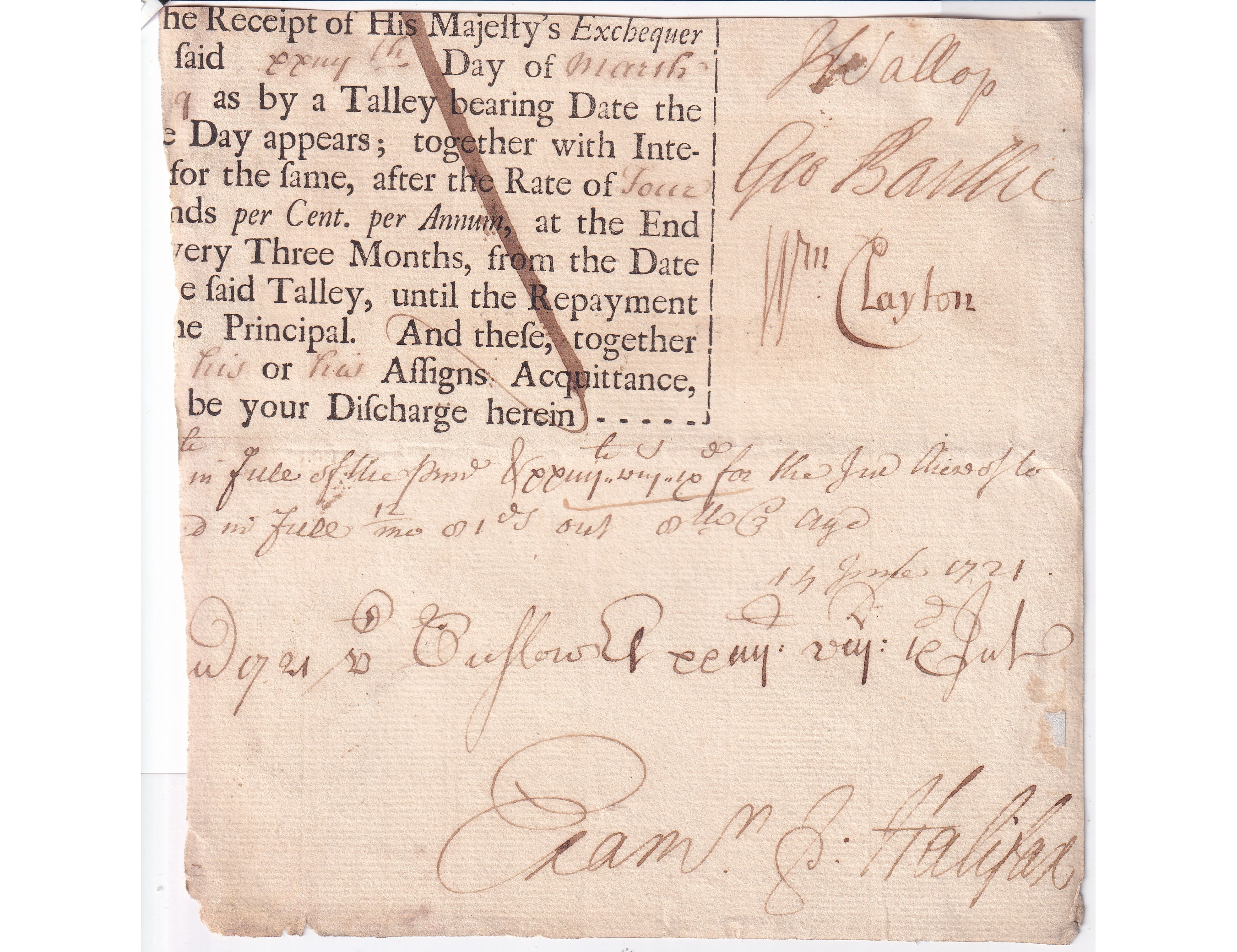
An important and highly attractive early Georgian Treasury and Exchequer document, being a surviving portion of a printed Treasury order for the repayment of an Exchequer loan, signed by three Lords Commissioners of the Treasury and later examined by the Auditor of the Receipt of the Exchequer.
The printed text concerns repayment of money advanced to the Crown and secured by a tally issued at the Receipt of the Exchequer, together with interest:
“…together with Interest for the same, after the Rate of Four Pounds per Cent. per Annum, at the End of every Three Months…”
The document bears the contemporary signatures of:
- John Wallop (1690-1762), later 1st Earl of Portsmouth
- George Baillie (1664-1738), Treasury Commissioner and Scottish politician
- William Clayton (1671-1752), later 1st Baron Sundon
The signatures were applied in their official capacities as Lords Commissioners of the Treasury, forming the Treasury authorisation for repayment of the loan and accrued interest. These are not casual autograph endorsements but signatures which gave the Treasury order its legal force.
The lower section contains manuscript accounting endorsements and examination notes, including:
“Exam’d G. Halifax”
being the signature of George Montagu, 1st Earl of Halifax (1685-1739), then serving as Auditor of the Receipt of the Exchequer, the office responsible for examining and recording transactions passing through the Exchequer.
The printed text preserves a manuscript date insertion of 24 March, while a surviving figure immediately preceding the words “as by a Talley bearing Date” appears to be the final digit of the original year. Because the left margin has been trimmed, the preceding digits are lost, but the surviving figure is consistent with 1719, a date which accords with the Treasury commissioners present and the apparent later endorsement date of 14 June 1721. This attribution is therefore considered highly probable, though the trimming prevents complete certainty.
Historically, the document falls within the era of Britain’s rapidly expanding national debt system and the years immediately surrounding the South Sea Bubble. It represents a surviving piece of the machinery by which government borrowing was administered, interest paid, and public loans ultimately redeemed through the Treasury and Exchequer.
In modern terms, this document may be compared to a government bond redemption authorisation signed by senior Treasury ministers and processed through the national audit system.
It is trimmed at the upper and left margins with loss of part of the printed text. The principal printed wording survives together with all three Treasury signatures, extensive contemporary manuscript endorsements, and the Halifax examination signature. An attractive and historically important display piece.
A scarce and desirable item for collectors of Treasury, Exchequer, financial, parliamentary, political and eighteenth-century historical manuscripts.
Provenance:
One of c.2,500+ items once from the collection or dealer stock of Winifred A Myers (Autographs) Ltd, St Martins Lane, London, evidenced by the quantity of Myers pre-printed envelopes and paper folders and the general ‘presentation’ of the items, many having Myers identification notes in pencil.
Winifred Alice Myers (1909 – 1985) served as ABA (Antiquarian Booksellers Assoc) president, 1950-1952. See the ABA website for an extended article on Myers. Myers left her business, in 1985, to Ruth Shepherd, who traded from home until 2004.


John Wallop, 1st Earl of Portsmouth (Apr 1690 – Nov 1762), of Hurstbourne Park, near Whitchurch and Farleigh Wallop, Hampshire, known as John Wallop, 1st Viscount Lymington from 1720 to 1743, was a British politician who sat in the House of Commons from 1715 to 1720, when he vacated his seat on being raised to the peerage as Viscount Lymington and Baron Wallop.
George Baillie (Mar 1664 – Aug 1738) was a Scottish politician who sat in the Parliament of Scotland from 1691 to 1707 and in the British House of Commons from 1708 to 1734.
William Clayton, 1st Baron Sundon (1671 – Apr 1752), of Sundon Hall, Sundon, Bedfordshire, was a British Treasury official and politician who sat in the House of Commons from 1716 to 1752.
George Montagu, 1st Earl of Halifax PC KB (c. 1684 – May 1739), of Horton, Northamptonshire, was a British Whig politician who sat in the House of Commons from 1705 to 1715 when he became a peer.
Leave a Reply