
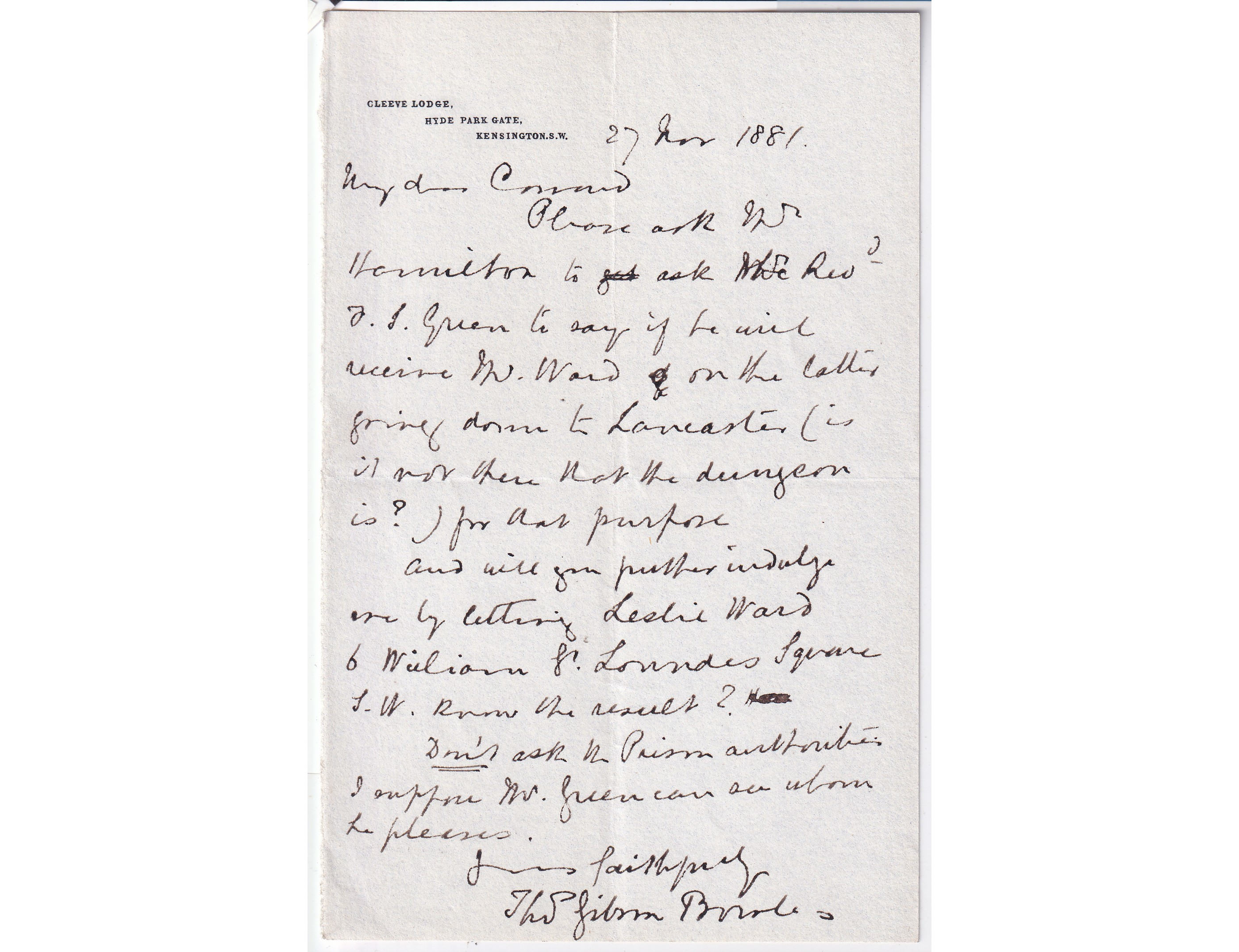
In the world of Victorian satire, few editorial figures were as audacious, mischievous, and socially well‑connected as Thomas Gibson Bowles, founder of Vanity Fair. His star caricaturist, Leslie Ward (“Spy”), became one of the most recognisable artistic voices of the age, producing hundreds of iconic full‑page lithographs of politicians, judges, aristocrats, and public personalities.
Every now and then, a document surfaces that reveals how Bowles actually operated behind the scenes — the private networks, the discreet intermediaries, the humour, the cheek, and the occasional willingness to bend rules to get Spy in front of the right subject.
One such document is an Autograph Letter Signed, dated 27 November 1881, in which Bowles attempts to arrange a covert visit for Spy to meet one of the most controversial clergymen in Victorian Britain: The Reverend Sidney Faithorn Green, imprisoned in Lancaster Castle under the Public Worship Regulation Act.
This letter is not merely interesting. It is a rare, narrative‑rich artefact from the height of the Ritualist controversy.
The Ritualist Martyr in the Dungeon
Rev. S. F. Green was arrested on 19 March 1881 for refusing to abandon Anglo‑Catholic ritual in his parish. Under the Public Worship Regulation Act (1874), he was imprisoned for contempt of court — a punishment that shocked the nation.
Green spent around 20 months in Lancaster Castle, finally being released on 4 November 1882.
The conditions were notorious. Victorian commentators repeatedly referred to the medieval cells as “the dungeon.” Bowles himself echoes this public rhetoric in the letter:
“is it not there that the dungeon is?”
This is classic Bowles — humorous, knowing, and slightly theatrical.
But the real revelation comes a few lines later.
Bowles’s Covert Instruction: “Don’t ask the Prison authorities.”
In the middle of the letter, Bowles writes:
“Don’t ask the Prison authorities. I suppose Mr. Green can see whom he pleases.”
This single sentence transforms the entire document.
Bowles is not simply arranging a polite introduction. He is attempting to slip Spy into Lancaster Castle without official permission.
This is Bowles at his most characteristic:
- cheeky
- anti‑authoritarian
- confident
- socially strategic
- and absolutely determined to get Spy in front of the right subject
It also reveals something important about the Vanity Fair editorial process: Bowles often arranged sittings quietly, using private intermediaries, keeping Spy uninformed until arrangements were confirmed.
The Single‑Ward Theory: Mr Ward = Leslie Ward (“Spy”)
The letter refers first to “Mr Ward”, and later gives the full address:
“Leslie Ward, 6 William St., Lowndes Square S.W.”
Rather than indicating two different men, the structure makes perfect sense if Bowles is referring to the same person — Spy — but shifts from casual mention to precise instruction.
Bowles often added full addresses as aide‑mémoire for intermediaries, ensuring messages reached the correct individual. In this case, Bowles is writing to a trusted acquaintance, Conrad, who is to:
- Ask Mr Hamilton to approach Rev. Green
- Determine whether Green will receive Spy
- Relay the outcome to Spy at his Lowndes Square address
This workflow is entirely consistent with Bowles’s editorial habits.
Why Spy? Why Green? Why Now?
The timing is perfect.
On 27 November 1881, Green was:
- eight months into his imprisonment
- a national cause célèbre
- a lightning rod for ecclesiastical politics
- widely discussed in Parliament and the press
- a visually distinctive figure (tall, gaunt, ascetic)
Bowles would absolutely have thought:
“Spy should sketch this man.”
Even though no caricature of Green was ever published, the attempt itself is historically valuable. It shows Vanity Fair actively engaging with one of the most explosive religious controversies of the Victorian era.
A Rare Glimpse into Bowles’s Editorial Machinery
This ALS is more than a letter. It is a snapshot of Bowles’s private network, revealing:
- his reliance on discreet intermediaries
- his willingness to bypass official channels
- his humour and irreverence
- his editorial instincts
- his management of Spy’s assignments
- his engagement with national controversies
- his confidence in social manoeuvring
It is also a rare example of an unrealised caricature — the kind of behind‑the‑scenes moment collectors prize.
Conclusion: A Premium Victorian Manuscript
This 1881 ALS sits at the intersection of:
- Vanity Fair history
- Spy’s artistic career
- the Ritualist controversy
- Lancaster Castle prison history
- Victorian ecclesiastical politics
- Bowles’s editorial personality
The letter’s combination of humour, covert instruction, and historical context makes it a standout piece — one of the most revealing Bowles letters to surface in recent years.


Thomas Gibson Bowles (Jan 1841 – Jan 1922) was a British politician and publisher. He founded the magazines The Lady and Vanity Fair, and became a Member of Parliament in 1892. He was also the maternal grandfather of the Mitford sisters.
Sir Leslie Matthew Ward (Nov 1851 – May 1922) was a British portrait artist and caricaturist who over four decades painted 1,325 portraits which were regularly published by Vanity Fair, under the pseudonyms “Spy” and “Drawl”. The portraits were produced as watercolours and turned into chromolithographs for publication in the magazine. These were then usually reproduced on better paper and sold as prints. Such was his influence in the genre that all Vanity Fair caricatures are sometimes referred to as “Spy cartoons” regardless of who the artist actually was.
Sidney Faithorn Green (1841 – 1916) was an English clergyman who, during the Ritualist controversies in the Church of England, was imprisoned for 20 months for liturgical practice contrary to the Public Worship Regulation Act 1874.
.
Leave a Reply