
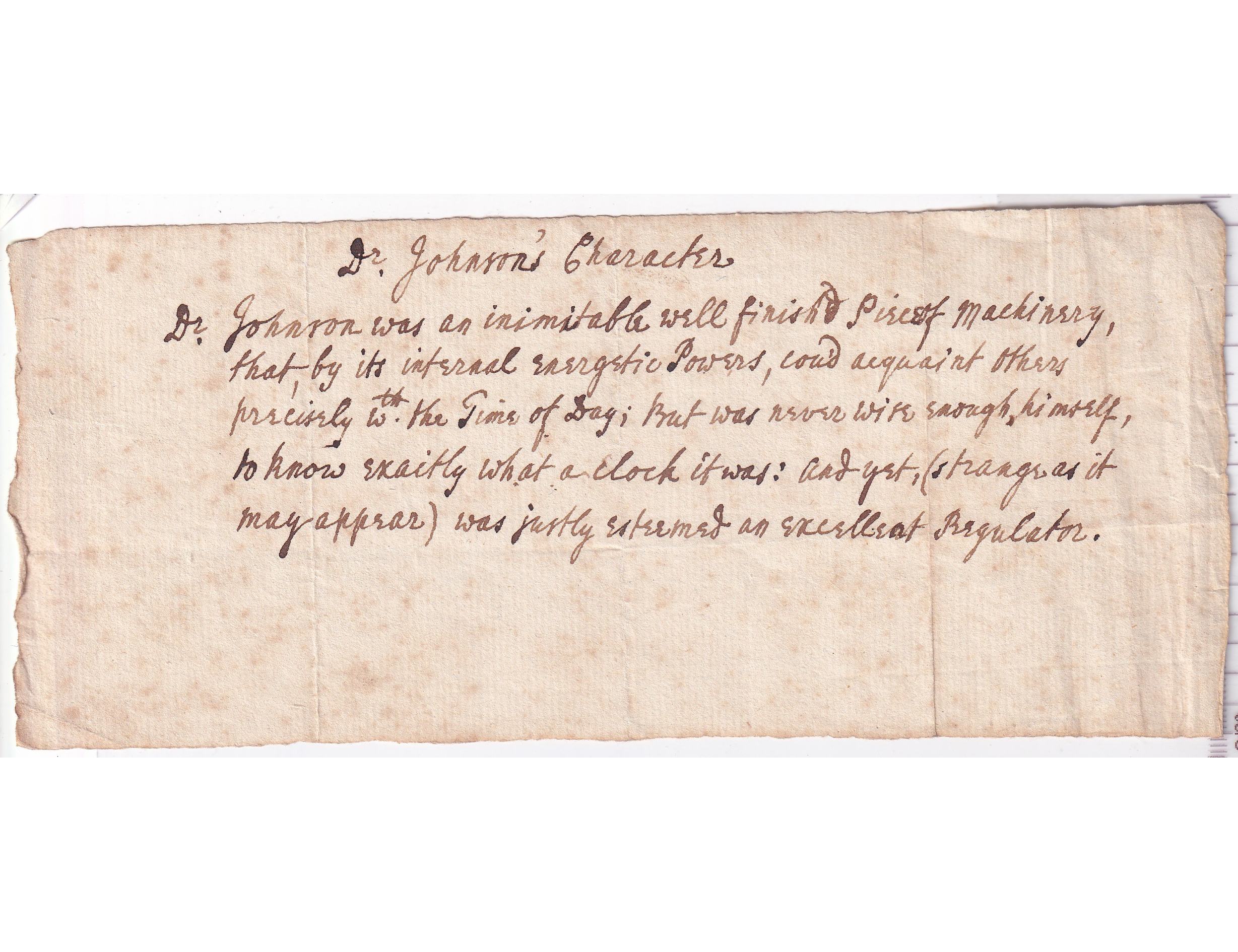
SAMUEL JOHNSON – CONTEMPORARY CHARACTER SKETCH – c.1790–1820 Standalone manuscript leaf – witty epigrammatic “character” – Johnsoniana
A neatly penned late‑18th/early‑19th‑century manuscript leaf containing a polished, self‑contained “character” of Dr Samuel Johnson. Written in a clear period hand (likely c.1790–1820), this short epigram presents Johnson as an “inimitable well finish’d piece of machinery” whose internal powers could tell others “the time of day,” though he himself “was never wise enough to know exactly what a clock it was.” A sharp, metaphorical assessment entirely in keeping with early Johnson reception.
This is a standalone manuscript, not cut from a commonplace book or album. No binding scars, no pagination, no offsetting — the text is centred and composed as a complete unit, typical of loose literary leaves circulated privately in the decades after Johnson’s death (1784). Such leaves often contained epigrams, reflections, or “characters” in the Theophrastan tradition, copied for personal use or sharing among friends.
Content (full transcription): Dr. Johnson’s Character Dr. Johnson was an inimitable well finish’d Piece of machinery, that, by its internal energetic Powers, cou’d acquaint others precisely wth. the Time of Day; but was never wise enough, himself, to know exactly what a clock it was: And yet, (strange as it may appear) was justly esteem’d an excellent Regulator.
The metaphor aligns closely with themes found in early Johnson commentary (Murphy, Thrale, Boswell), though the hand is anonymous and the text does not match any known printed source. It may be an original composition or a fair copy of a now‑lost anecdotal remark — a cautious assumption only.
Johnson’s death triggered a wave of posthumous “characters” and epigrams. Writers frequently produced short metaphorical sketches of his personality, often circulated on single sheets. This leaf fits that tradition precisely: polished, epigrammatic, and designed as a standalone piece.
Provenance:
One of c.2,500+ items once from the collection or dealer stock of Winifred A Myers (Autographs) Ltd, St Martins Lane, London, evidenced by the quantity of Myers pre-printed envelopes and paper folders and the general ‘presentation’ of the items, many having Myers identification notes in pencil.
Winifred Alice Myers (1909 – 1985) served as ABA (Antiquarian Booksellers Assoc) president, 1950-1952. See the ABA website for an extended article on Myers. Myers left her business, in 1985, to Ruth Shepherd, who traded from home until 2004.


Samuel Johnson (Sep 1709 – Dec 1784), often called Dr Johnson, was an English writer and polymath who made lasting contributions as a poet, playwright, essayist, moralist, literary critic, sermonist, biographer, editor, and lexicographer (creator of dictionaries). The work for which he is best known is his 42,733-entry Dictionary of the English Language (1755). For this and other contributions in and to the English language, the Oxford Dictionary of National Biography has called him “arguably the most distinguished man of letters in English history”
Leave a Reply