
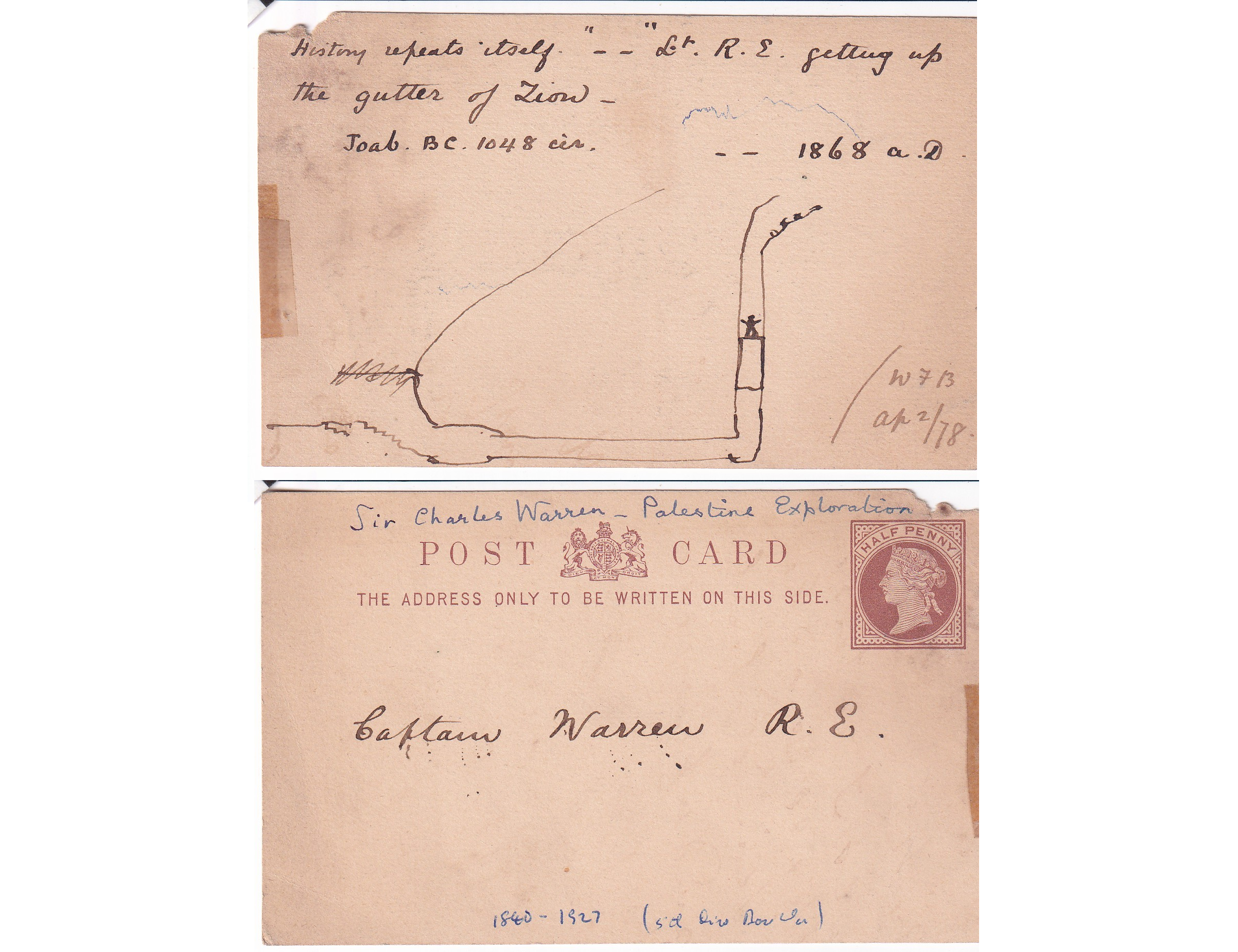
Charles Warren R.E. – 1878 Postcard with Ink Sketch by Rev. William Francis Birch (Palestine Exploration Fund ‘PEF’ Biblical Topographer)
Original ink‑sketch postcard sent to Warren during early debates on Jerusalem topography
Description: An exceptional and historically significant 1878 ink‑sketch postcard addressed to Captain Charles Warren R.E. (later Major‑General Sir Charles Warren, Commissioner of the Metropolitan Police at time of Jack the Ripper). The postcard contains a contemporary ink drawing and caption referencing Warren’s famous 1867–68 exploration of the vertical water shaft now known as Warren’s Shaft in Jerusalem.
The verso bears the humorous caption:
“History repeats itself” — “Lt. R. E. getting up the gutter of Zion” — Joab. B.C. 1048 cir. — 1868 A.D.”
This is a biblical‑engineering comparison between Joab’s ascent of the tsinnor (2 Samuel 5:8) and Warren’s Royal Engineers climbing the Jerusalem shaft in 1868.
In the lower right corner appears the period ink signature:
“W. F. B. apr 2 / ’78”
This identifies the sender as Reverend William Francis Birch (1840–1916), one of the most prolific, vocal, and persistent biblical topographers associated with the Palestine Exploration Fund (PEF).
Historical Context: Between 1877 and the 1890s, Birch was one of the PEF’s most active contributors, regularly publishing letters, critiques, and topographical theories in the Quarterly Statements. He spent years aggressively debating Warren’s archaeological conclusions, especially the placement of:
- Zion
- Akra
- Ophel
- The Valley of Hinnom
- The tsinnor (“gutter of Zion”)
- Jerusalem’s ancient gates
Birch frequently responded directly to Warren’s publications, often submitting counter‑arguments, corrected diagrams, and alternative excavation plans. His work was so persistent that the PEF noted in 1894 that Birch’s views appeared “in many numbers of the Quarterly Statement.”
This postcard is a rare surviving piece of private scholarly correspondence between Birch and Warren, illustrating the early stages of a debate that continued for nearly two decades.
Philatelic Note: The postcard is printed on the standard ½d Queen Victoria postal stationery, introduced in 1870 and fully valid throughout the 1870s and 1880s. The ½d vermilion pre‑printed stamp and layout match the Type III/IV 1875–1880 issue, making it exactly correct for the manuscript date of 2 April 1878. This confirms the card is chronologically authentic, with no mismatch between stationery and usage.
Technical Mapping Comparison: Modern archaeological reconstructions of Warren’s Shaft — including the Ritmeyer diagram — show that Birch’s 1878 sketch is remarkably accurate. Although mirrored in orientation. the drawing correctly represents:
- the vertical shaft,
- the inclined access tunnel,
- the upper chamber,
- and the approximate ascent route used by Warren’s Royal Engineers in 1868.
This demonstrates that Birch’s postcard was not merely humorous, but a competent technical illustration based on a detailed understanding of Warren’s Jerusalem discoveries. The accuracy of the sketch significantly enhances the item’s scholarly and collector value.
Provenance & Importance:
This postcard represents primary‑source documentation of the intellectual dialogue between Warren and Birch — two of the most influential figures in early Jerusalem archaeology. Items showing direct interaction between PEF scholars are extremely scarce, especially those containing original sketches and signed commentary.
A superb addition to collections of:
Jack the Ripper–related Warren material
Palestine Exploration Fund material
Biblical archaeology
Royal Engineers history
Warren’s Shaft / Jerusalem topography
Victorian scholarly correspondence
Historical Context
Princess Charlotte’s sudden death on 6 November 1817 caused national mourning. Her funeral on 19 November was a major state event. This letter was received 25 November 1817, only six days later — precisely when peers and officials sought eyewitness accounts from clergy involved in the Windsor procession.
Hopetoun’s metaphors and tone reflect a period of personal strain, aligning with his declining health after the Peninsular War.
The sheet shows age‑toning and staining, exactly as expected from an open, unsealed letter carried through the postal system in 1817. Because the sheet was sent flat and exposed, without folding or wax sealing, natural handling marks, light soiling, and surface staining are entirely consistent with its postal journey. Ink remains legible throughout; postal strikes are clear; the franking signature “Hopetoun” is strong. No folds, no creases, and no wax residue — confirming its original postcard‑format use.
Significance
- Pre‑stamp postcard‑format rarity
- Aristocratic franking signature (“Hopetoun”)
- Direct connection to Princess Charlotte’s funeral
- Windsor‑area clerical recipient
- Nautical metaphor content
- High‑quality paper
- National postal carriage of a card‑format sheet
This combination makes the item highly desirable across multiple collecting fields.
Provenance:
From a single owner collection of 3,000+ items. A chaotic uncatalogued miscellany of items from 17th to 20th Century.
Containing, amongst many other things: ALSs (Autograph Letters Signed); Signed Photos, Posters, Ephemera, Album pages; Clipped Signatures; Signed Free Fronts; Misc Manuscript Items; etc, etc.


Reverend William Francis Birch (1840 – 1916) was a prolific biblical topographer and one of the most persistent contributors to the Palestine Exploration Fund. Active from the late 1870s into the 1890s, Birch specialised in reconstructing ancient Jerusalem from Scripture and Josephus, frequently challenging the archaeological conclusions of Captain Charles Warren R.E. and Major Claude Conder. His many PEF Quarterly Statement submissions included detailed critiques, alternative site identifications, and hand‑drawn diagrams, making him one of the era’s most vocal and influential commentators on Zion, Ophel, Akra, and the City of David.
Sir Charles Warren (Feb 1840 – Jan 1927) was a British Army officer of the Royal Engineers. He was one of the earliest European archaeologists of the Biblical Holy Land, and particularly of the Temple Mount. Much of his military service was spent in British South Africa. Previously he was Commissioner of Police of the Metropolis, the head of the London Metropolitan Police, from 1886 to 1888 during the Jack the Ripper murders. His command in combat during the Second Boer War was irredeemably flawed, though he achieved considerable success during his long life in his military and civil posts.
Leave a Reply