
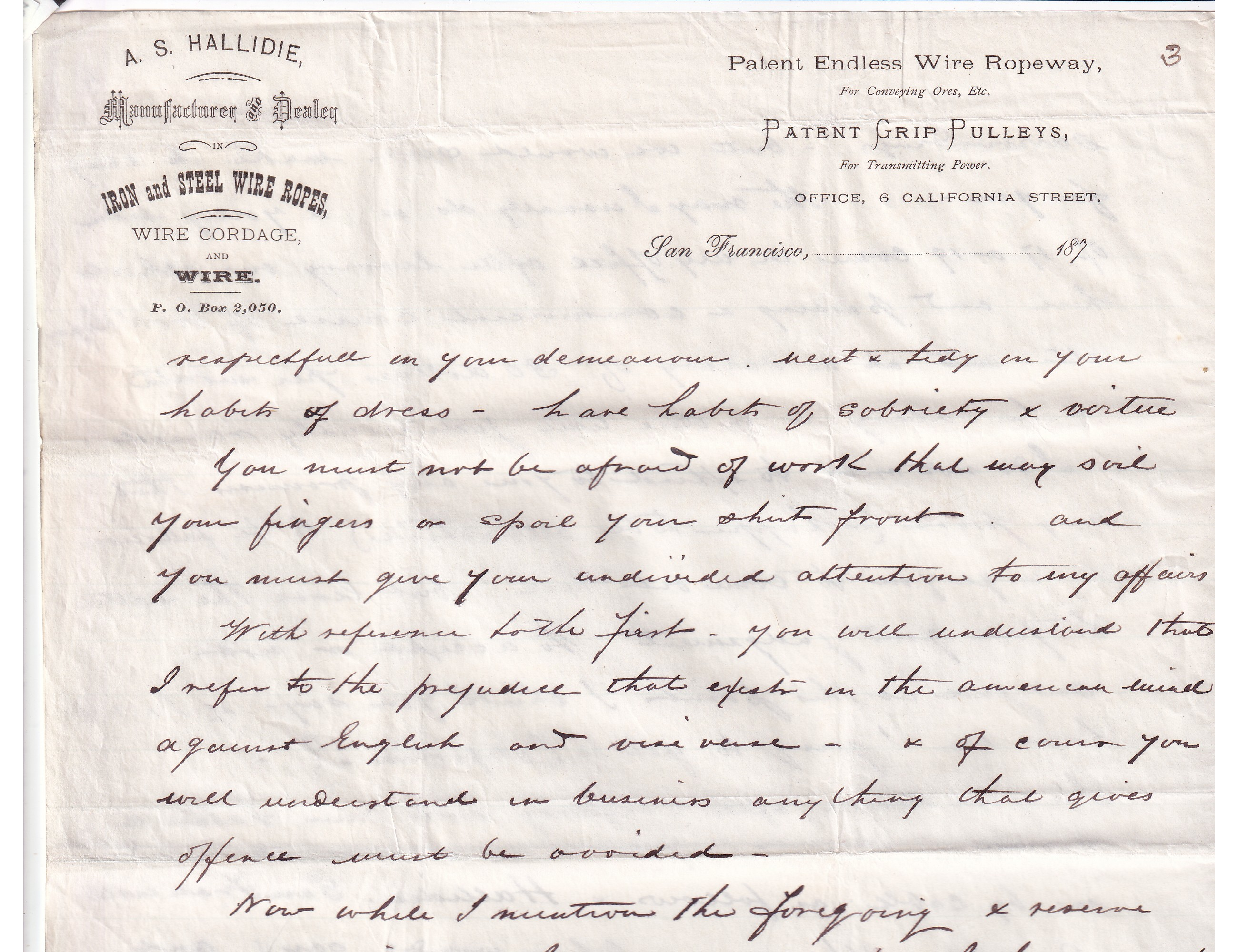
IWhen you handle historical manuscripts every day, you get used to the quiet thrill of opening an envelope and finding a voice waiting inside. But every so often, an archive arrives that feels different — deeper, more human, more consequential. The Hallidie family papers are exactly that kind of discovery: a 65‑year run of correspondence stretching from the optimism of 1870s California to the reflective calm of the 1930s, written by the inventor of the San Francisco cable car and his widow, Martha Elizabeth “Mattie” Hallidie.
This is not just a set of letters. It is a family story told across continents, generations, and changing eras — and it survives because someone cared enough to keep every page.
The Inventor’s Voice: Andrew Smith Hallidie, 1870–1878
Andrew Smith Hallidie (1836–1900) is best known today for the cable car — that iconic symbol of San Francisco climbing its impossible hills. But in these letters, he is not a public figure. He is simply “Uncle Andrew,” writing to his nephew Henry in London with warmth, humour, and a very Victorian sense of duty.
His 1870 and 1873 letters are full of encouragement:
“There is nothing like perseverance… and patience.”
He writes about Yosemite, the Big Trees, and the new transcontinental railway that could carry a traveller from New York to California in six days. He writes about education, character, and the importance of doing one’s best even when the world feels difficult.
And then comes the masterpiece: a 7‑page letter written across four sheets of his own wire‑rope company stationery, dated 1 January 1878. It is part job offer, part life advice, part survival manual for crossing the Atlantic and the American continent in winter. Hallidie explains everything:
- Which steamer line to take
- How to avoid trouble at New York customs
- Which hotel to trust
- How to book sleeper berths to Omaha, Ogden, and San Francisco
- How to behave in an American office
- How to telegraph him upon arrival
It is rare to see a 19th‑century industrialist write with such detail, care, and humanity. This letter alone is a small treasure.
A Family in Two Hemispheres
Henry never did emigrate, but the correspondence continued. By the 1920s, the family had spread across the world:
- Henry in England
- Aunt Alice and her husband Maurice McMicken in Seattle
- Aunt Emma living with her children
- And Mattie — Andrew’s widow — living quietly in San Francisco
The 1922 letter from Maurice McMicken is one of the most moving pieces in the archive. Written on law‑firm stationery, it describes Aunt Alice’s final illness with tenderness and clarity. It is the kind of letter families keep for generations.
Mattie Hallidie: A Life in Letters, 1929–1935
Martha Elizabeth “Mattie” Woods married Andrew in 1863. She lived until 1937, long enough to see the cable car become a symbol of the city her husband helped shape. In her eighties, she moved into the San Francisco Ladies’ Protection & Relief Society Home at 3400 Laguna Street — a dignified residence for gentlewomen of reduced means.
Her letters from 1929–1935 are warm, articulate, and full of small details that bring her world to life:
- The “large sunny room” she enjoys
- Her club outings
- Her almost total deafness, eased by an early hearing instrument
- Her pride in Henry’s children
- Her reflections on earthquakes, fog, and the changing city
- Her pneumonia in 1933 and slow recovery
She writes with humour and resilience:
“One must hope for the best, strive for it, and keep a smiling face.”
The archive also includes the Home’s 1929 printed brochure — a beautifully produced document tracing the institution’s origins back to 1854, when San Francisco was still a frontier town.
Why This Archive Matters
This collection is valuable not just because of who wrote it, but because of what it preserves:
- The private voice of a major Californian inventor
- A complete late‑life narrative of his widow
- A transatlantic family story
- A detailed 19th‑century emigration guide
- A 1922 bereavement letter of unusual depth
- A 1929 institutional history of women’s welfare in San Francisco
It is rare to find an archive that spans so many decades while remaining so coherent.
A Family Story Worth Preserving
For collectors, historians, and anyone who loves the texture of real lives, the Hallidie archive is a reminder that history is not only made in public. It is made in letters — in the quiet moments when someone sits down, picks up a pen, and writes to someone they love.


Andrew Smith Hallidie (Mar 1836 – Apr 1900) was an American entrepreneur who was the promoter of the Clay Street Hill Railroad in San Francisco. This was the world’s first practical cable car system, and Hallidie is often therefore regarded as the inventor of the cable car and father of the present day San Francisco cable car system, although both claims are open to dispute. He also introduced the manufacture of wire rope to California, and at an early age was a prolific builder of bridges in the Californian interior.
.
Leave a Reply