
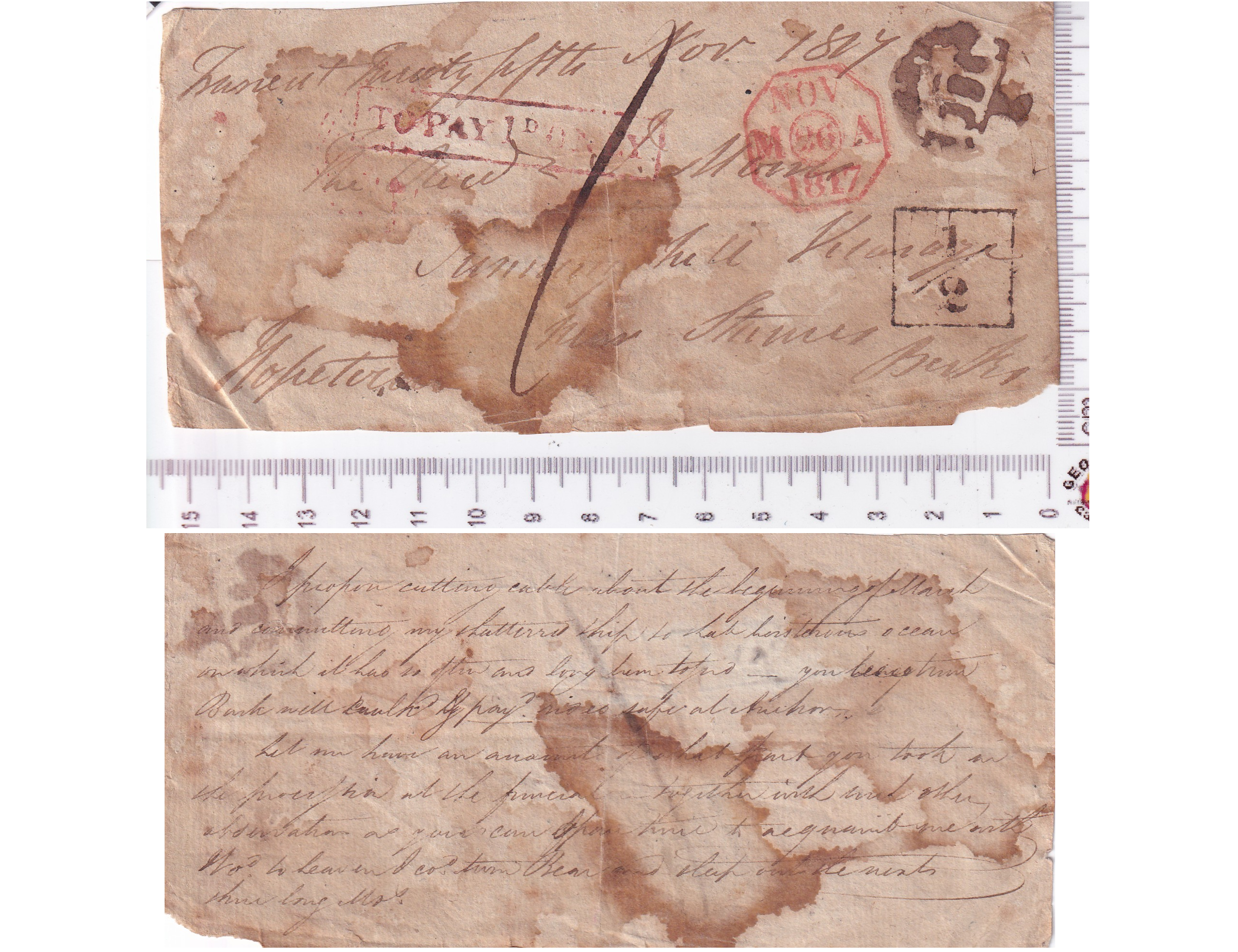
1817 OPEN “POSTCARD FORMAT” LETTER — SIGNED “HOPETOUN” — PRINCESS CHARLOTTE FUNERAL Addressed to an Unidentified Clergyman, Sunninghill Village, Near Staines, Berks
An exceptionally rare open single‑sheet letter, written on one side and addressed on the other — a true pre‑stamp postcard‑format item, decades before postcards were officially introduced. The sheet was sent completely flat, unfolded, and unsealed, with the entire front used as the address panel and postal markings, and the entire reverse containing the message. This is the early 19th‑century precursor to the modern postcard, carried through the national post at the full single‑sheet rate.
Signed “Hopetoun” — the franking signature of John Hope, 4th Earl of Hopetoun, Peninsular War general and senior Scottish peer. His signature appears at lower left of the address panel in the standard franking position.
Physical Format & Paper Quality
The sheet measures 155mm × 75mm (approx. 6″ × 3″), a size strikingly close to early postcard dimensions. It is written on high‑quality writing paper, not coarse stock or commercial waste. The combination of fine paper, small card‑like dimensions, and open postal carriage makes this a true pre‑stamp postcard precursor, carried through the national post more than half a century before postcards were officially introduced.
Address Panel (Front)
The Revd ——— Sunninghill Village Near Staines, Berks
Postal markings include:
- Red octagonal date stamp: NOV M 26 A 1817
- Red framed “TO PAY 1D ONLY”
- Black square framed “1/2” rate mark
- Diagonal clerk’s accounting stroke
- Franking signature “Hopetoun” in contemporary brown ink
This side is laid out exactly like a postcard, with the address and postal strikes occupying the entire face.
Message (Reverse)
The reverse contains Hopetoun’s vivid nautical metaphors, describing his own physical and emotional condition:
- “cutting cable about the beginning of March”
- “committing my shattered ship to that boisterous ocean”
- “Bark will be caulked & pay’d? More safe at Anchor”
These are technical naval repair terms — caulking and paying — used metaphorically to express fragility, recovery, and uncertainty following his military service.
Hopetoun requests a firsthand account of the recipient’s role in the funeral procession of Princess Charlotte of Wales, held at St George’s Chapel, Windsor on 19 November 1817:
- “Let me have an account of what part you took in the procession at the funeral…”
This places the recipient as a Windsor‑area clergyman, resident at Sunninghill Village, likely connected to St George’s Chapel. His exact identity is unidentified, as the surname is too faded to recover.
Historical Context
Princess Charlotte’s sudden death on 6 November 1817 caused national mourning. Her funeral on 19 November was a major state event. This letter was received 25 November 1817, only six days later — precisely when peers and officials sought eyewitness accounts from clergy involved in the Windsor procession.
Hopetoun’s metaphors and tone reflect a period of personal strain, aligning with his declining health after the Peninsular War.
The sheet shows age‑toning and staining, exactly as expected from an open, unsealed letter carried through the postal system in 1817. Because the sheet was sent flat and exposed, without folding or wax sealing, natural handling marks, light soiling, and surface staining are entirely consistent with its postal journey. Ink remains legible throughout; postal strikes are clear; the franking signature “Hopetoun” is strong. No folds, no creases, and no wax residue — confirming its original postcard‑format use.
Significance
- Pre‑stamp postcard‑format rarity
- Aristocratic franking signature (“Hopetoun”)
- Direct connection to Princess Charlotte’s funeral
- Windsor‑area clerical recipient
- Nautical metaphor content
- High‑quality paper
- National postal carriage of a card‑format sheet
This combination makes the item highly desirable across multiple collecting fields.
Provenance:
One of c.2,500+ items once from the collection or dealer stock of Winifred A Myers (Autographs) Ltd, St Martins Lane, London, evidenced by the quantity of Myers pre-printed envelopes and paper folders and the general ‘presentation’ of the items, many having Myers identification notes in pencil.
Winifred Alice Myers (1909 – 1985) served as ABA (Antiquarian Booksellers Assoc) president, 1950-1952. See the ABA website for an extended article on Myers. Myers left her business, in 1985, to Ruth Shepherd, who traded from home until 2004.


General John Hope, 4th Earl of Hopetoun, GCB, PC (Ire), FRSE (Aug 1765 – Aug 1823), known as The Honourable John Hope from 1781 to 1814 and as Lord Niddry from 1814 to 1816, was a British Army officer and politician.
Princess Charlotte of Wales (Charlotte Augusta; Jan 1796 – Nov 1817) was the only child of George, Prince of Wales (later George IV), and Caroline of Brunswick. She was expected to ascend the British throne after the deaths of her grandfather, George III, and her father, but died in childbirth at the age of 21, predeceasing them both.
Leave a Reply