
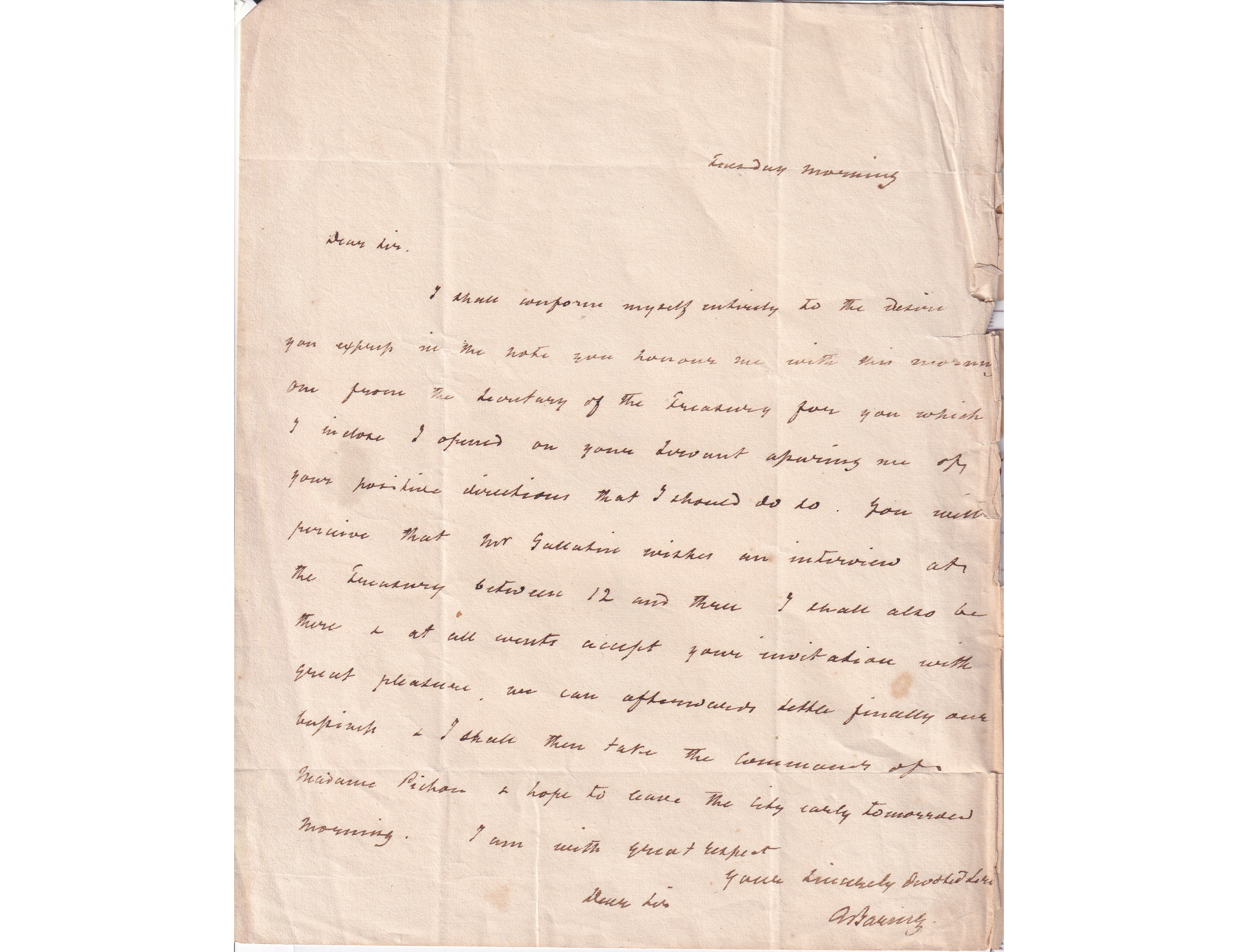
ALEXANDER BARING (FUTURE 1st BARON ASHBURTON) – AUTOGRAPH LETTER SIGNED (ALS), WASHINGTON, c.1801–1803 – EARLY U.S. DIPLOMATIC–FINANCIAL LETTER ON A SINGLE FOLDED SHEET, WITH ADDRESS PANEL TO MONSIEUR PICHON
Author: Alexander Baring (1774–1848), later 1st Baron Ashburton Date: c.1801–1803 (Jefferson administration) Place of writing: Washington, D.C., United States Address panel: Monsieur Pichon (Louis‑André Pichon, French Chargé d’Affaires)
A rare early American‑period letter from Alexander Baring, written during his years in the United States when he served as the Barings’ principal agent and operated within the core of Jefferson‑era fiscal and diplomatic activity. The letter is written on a single folded bifolium sheet, with page 4 serving as the original address panel, directed to “Monsieur Pichon” — Louis‑André Pichon, the French Chargé d’Affaires in Washington.
The content reflects Baring’s close involvement with the U.S. Treasury and the French legation during the delicate post‑Quasi‑War rapprochement. He reports opening official correspondence under instruction, arranging a meeting at the Treasury, and taking “the commands of Madame Pichon” before leaving the city early the next morning. This is a vivid example of the diplomatic–financial coordination that characterised Baring’s American period.
The fact that the address panel is part of the same lettersheet — not a separate cover — provides direct evidence of diplomatic routing through the French legation. This is typical of early Washington correspondence, where letters were often carried under outer address to a diplomatic household even when the internal content concerned Treasury business.
Physical Description
- Single folded bifolium sheet
- Page 4 used as the address panel to Monsieur Pichon
- Red wax seal remnants present
- Clear early‑period signature “A. Baring”
- Strong ink, very good legibility
- Light folds and minor age‑wear consistent with carriage
This letter dates from the period when Alexander Baring was stationed in America (1794–1803), acting as the Barings’ agent and moving within the inner circle of Jefferson‑era fiscal and diplomatic operations. His interactions with the Pichon household are well documented, and surviving letters showing direct diplomatic routing are scarce.
The combination of:
- early Baring
- Washington origin
- French legation address
- Treasury‑related content
makes this a high‑value example of early U.S.–French diplomatic correspondence.
Provenance:
One of c.2,500+ items once from the collection or dealer stock of Winifred A Myers (Autographs) Ltd, St Martins Lane, London, evidenced by the quantity of Myers pre-printed envelopes and paper folders and the general ‘presentation’ of the items, many having Myers identification notes in pencil.
Winifred Alice Myers (1909 – 1985) served as ABA (Antiquarian Booksellers Assoc) president, 1950-1952. See the ABA website for an extended article on Myers. Myers left her business, in 1985, to Ruth Shepherd, who traded from home until 2004.


Alexander Baring, 1st Baron Ashburton (Oct 1774 – May 1848) was a British politician, diplomat and financier. A member of the Baring family, he was the second son of Sir Francis Baring, 1st Baronet.
Louis-André Pichon (Nov 1771 – 1854) was a French diplomat, and French ambassador to the United States, particularly during the Louisiana Purchase
Abraham Alfonse Albert Gallatin (Jan 1761 – Aug 1849) was a Genevan-American politician, diplomat, ethnologist, and linguist. Often described as “America’s Swiss Founding Father”, he was a leading figure in the early years of the United States, helping shape the new republic’s financial system and foreign policy. Gallatin was a prominent member of the Democratic-Republican Party, represented Pennsylvania in both chambers of Congress, and held several influential roles across four presidencies, most notably as the longest serving U.S. secretary of the treasury. He is also known for his contributions to academia, namely as the founder of New York University and cofounder of the American Ethnological Society.
Leave a Reply