
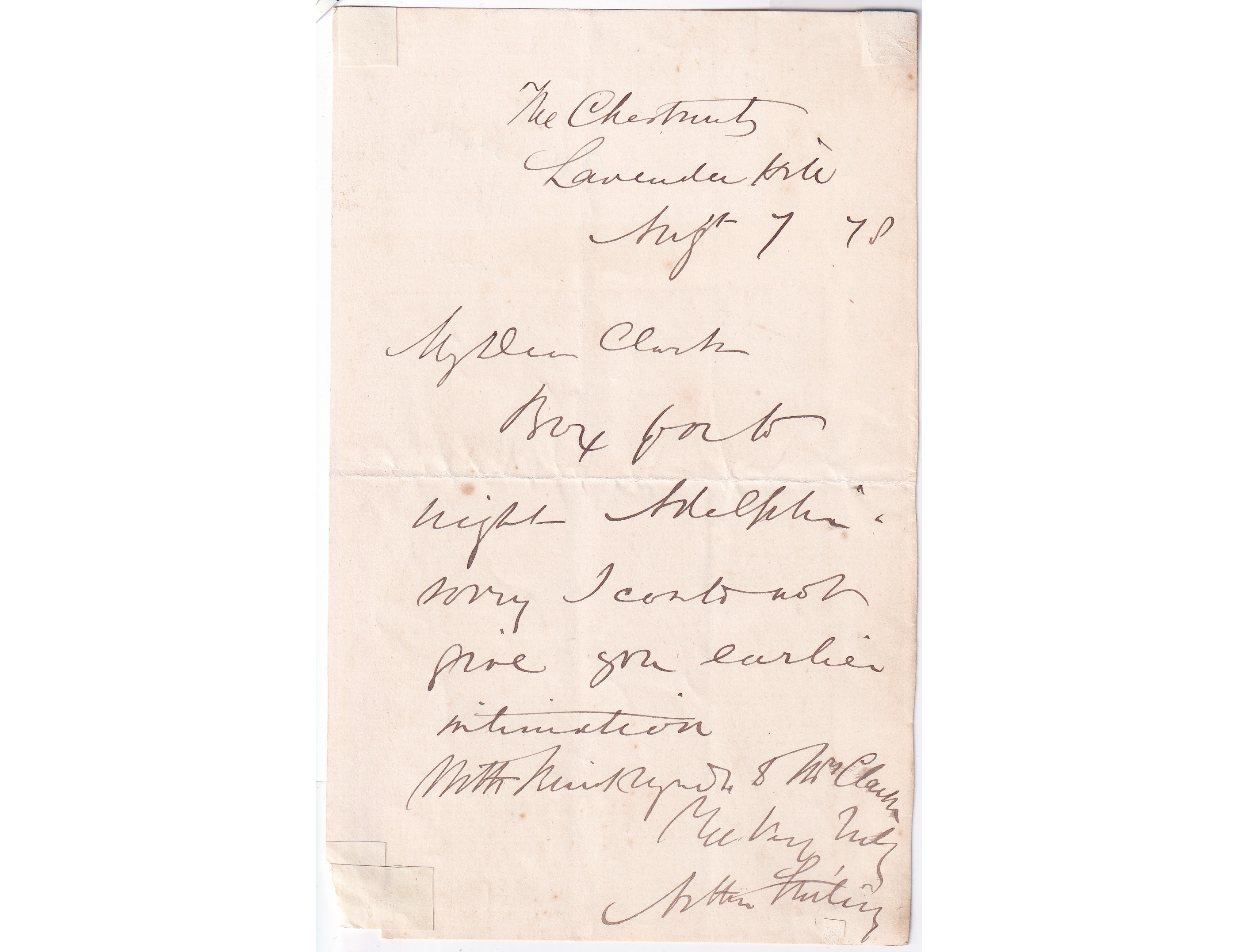
It is early evening on 7 August 1878, and I am at home at The Chestnuts, Lavender Hill, preparing for another night on the Adelphi stage. The windows are open to tIt is early evening on 7 August 1878, and I am at home at The Chestnuts, Lavender Hill, preparing for another night on the Adelphi stage. The windows are open to the warm air, and my wife — Mrs Arthur Stirling, who will also be performing tonight — is checking over a few small costume pieces: ribbons, jewellery, and the little personal touches that never leave the dressing room.
Most of the real preparation will happen at the theatre — wigs, grease‑paint, costume fittings — but there is always a quiet moment at home before the night begins.
Tonight, we play in A Celebrated Case. I will be Lazare, and Mrs Stirling will be Madame Deprets. My fellow actors will be there too: Charles Harcourt as the Duke, Mrs John Billington as the Duchess, Luigi Lablache as Victor, and Bella Pateman as Adrienne. A strong company — one I have worked beside for years.
Before we leave, I sit at my writing desk and dash off a note to my friend Clark. I have managed to secure a box for tonight’s performance, and though the message is late, I hope it will be welcome.
“My Dear Clark Box for you to night Adelphi. Sorry I could not give you earlier intimation. With kind regards to Mrs Clark Yours very truly Stirling”
The letter sealed, we gather our things — small personal items, nothing more — and step out into the warm August evening.
The Walk to the Adelphi
Lavender Hill is lively at this hour. Carriages rattle past, children call to one another, and the smell of supper drifts from open windows. We make our way toward the river, cross into the bustle of the Strand, and finally reach the Adelphi’s stage door, where the doorman nods us through without ceremony.
Inside, the familiar world of backstage life unfolds.
Backstage: Wig, Grease‑paint, Costume
The dressing rooms are already busy. This is where the real transformation happens.
I take my place at the long mirror, surrounded by the noise of the company preparing for the night. The wig‑master brings over my wig — curled, brushed, and pinned to withstand the heat of the gas lamps. The wardrobe mistress checks my coat, making sure the mended seams will hold.
Then the grease‑paint:
- a base of zinc white
- shadows around the eyes
- a darker tone to sharpen the cheekbones
- powder to set it under the lamps
Around me, the company warms up:
- Frank Moreland loosening his voice after Sarah’s Young Man
- Herbert Waring adjusting his sergeant’s uniform
- Frederick Hughes preparing for Shrimps for Two
- Miss Hudspeth rehearsing her lines one last time
Stagehands haul scenery, the orchestra tunes in the pit, and the smell of gaslight and paint fills the air. It is organised chaos — the heartbeat of Victorian theatre.
My wife finishes her own preparations beside me, securing her wig and smoothing her costume for Madame Deprets. We exchange a quiet smile. We have performed together many times; there is comfort in that.
Curtain Up
By the time the audience settles into their seats — Clark among them, I hope — we are ready. The gas lamps flare, the curtain rises, and the world of A Celebrated Case unfolds once more.
It is just one night in a long career, but it is a night preserved: in a letter written from Lavender Hill, in the bustle of backstage preparation, and in the shared work of a husband and wife stepping together into the light of the Adelphi stage.
Footnote: Sources Used to Reconstruct This GRWM
This narrative is reconstructed from:
The Daily Calendars — The Adelphi Theatre Calendar: A Record of Dramatic Performances at a Leading Victorian Theatre (formerly the Sans Pareil, 1806–1819; later the Adelphi, 1819–1900)”, which records the full cast list for Wednesday Evening, 7 August 1878, including all actors named above.
Arthur Stirling’s autograph letter, dated 7 August 1878, written from The Chestnuts, Lavender Hill, offering a complimentary box at the Adelphi Theatre.


Leave a Reply