
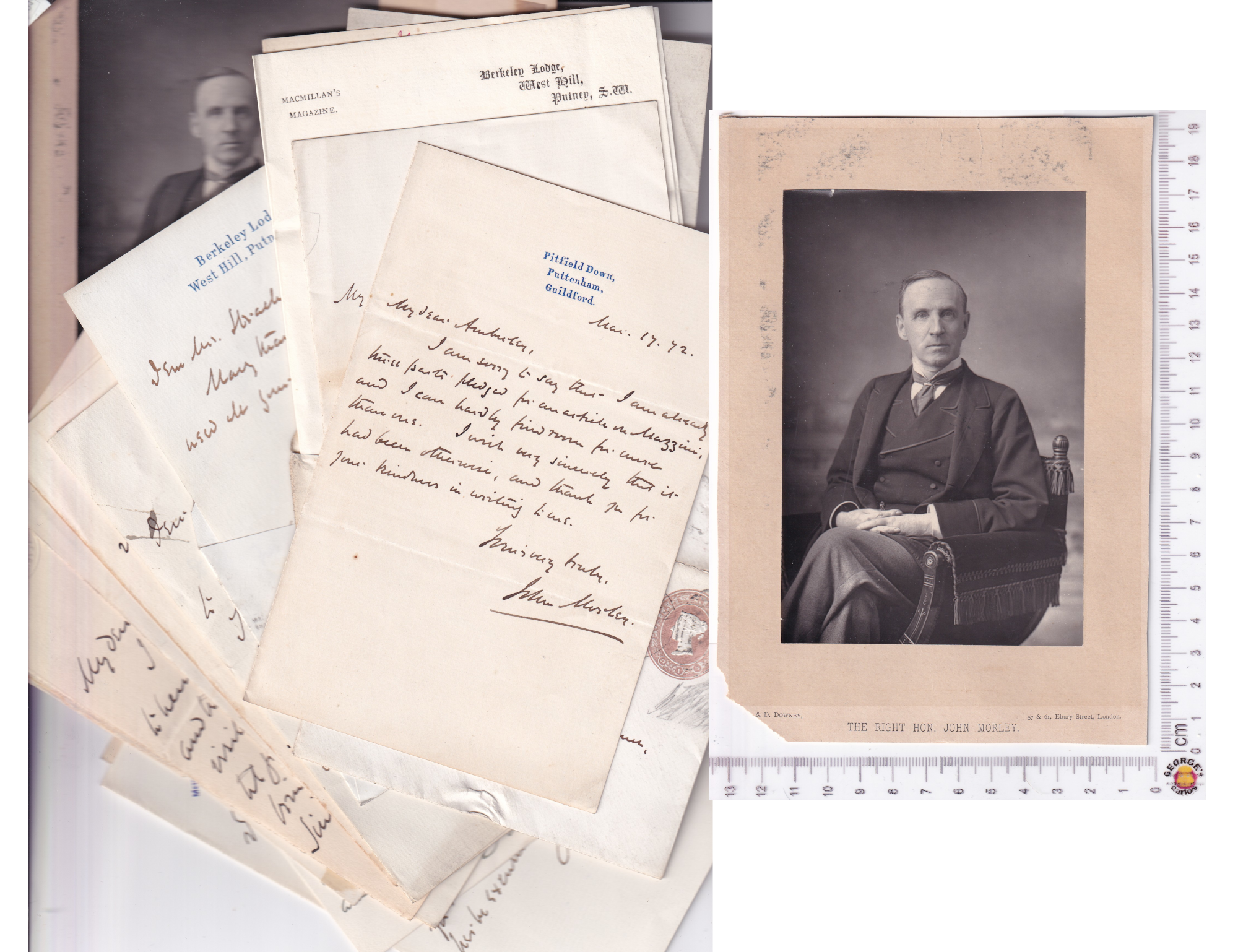
Political culture, intellectual networks, and manuscript evidence across a long Victorian life
The newly catalogued archive of twenty‑two autograph letters written by John Morley (1838–1923) offers an unusually coherent primary source for examining the intellectual, political, and social networks of one of the most influential Liberal thinkers of the late nineteenth and early twentieth centuries. Spanning nearly fifty years, from 1878 to 1922, the collection provides a longitudinal view of Morley’s professional commitments, personal relationships, and evolving public role.
The letters trace Morley’s movements across three principal residences — Putney, South Kensington, and Wimbledon Park — and the survival of envelopes, embossed stationery, and postal marks provides valuable material evidence for scholars of Victorian postal culture and manuscript studies. The inclusion of a contemporary W. & D. Downey cabinet portrait further situates the archive within the visual culture of late‑Victorian public life.
Several letters illuminate Morley’s editorial work, particularly during his tenure at Macmillan’s Magazine. His correspondence with contributors — including a polite but firm rejection of a submitted paper — reflects the pressures of Victorian periodical culture and the editorial gatekeeping that shaped literary production. These letters contribute to broader studies of Liberal intellectual journalism, a field in which Morley played a central role.
Other letters document Morley’s parliamentary duties: requests for Strangers’ Gallery tickets, references to Joseph Chamberlain, and engagements with political colleagues such as W. E. Forster. These documents offer insight into the everyday mechanics of political life — the informal negotiations, social obligations, and administrative burdens that accompanied Morley’s ministerial career.
Among the most significant items are four letters addressed to Jane Maria Strachey (1840–1928), a prominent suffragist, writer, and organiser within the National Union of Women’s Suffrage Societies. Morley’s correspondence with Strachey situates him within a Liberal milieu that intersected with the women’s movement, even if his own stance on suffrage was cautious. The letters demonstrate the intellectual respect Morley accorded to Strachey, the social proximity between Liberal reformers and suffrage activists, and the gendered dynamics of committee work and political labour.
One letter, dated 8 October 1898, is written on stationery bearing the blind‑embossed crest of the British Museum. The recipient is James George Frazer Bright, Assistant Keeper in the Department of Printed Books. This identification situates Morley within the intellectual networks of the Museum and contributes to the institutional history of the Printed Books Department.
The final letter in the sequence, written in 1922, contains a strikingly pessimistic observation: “Times are changed… by no means for the better.” This brief remark encapsulates the disillusionment felt by many late‑Victorian Liberals in the aftermath of the First World War and the decline of the political culture to which Morley had devoted his life.
Taken together, the letters offer a continuous primary‑source record of Morley’s public and private engagements, evidence for Victorian and Edwardian political culture, insights into editorial practice and the literary marketplace, documentation of Liberal–suffrage networks, and material for manuscript studies, including postal history and stationery analysis. The archive is therefore of interest to scholars of political history, gender studies, book history, and Victorian intellectual culture.


John Morley (1838–1923) Liberal statesman, Chief Secretary for Ireland, biographer of Gladstone, editor of Macmillan’s Magazine and the Pall Mall Gazette. A leading political thinker of the late Victorian and Edwardian periods.
Jane Maria Strachey, Lady Strachey (1840–1928) English suffragist, writer, and senior figure in the National Union of Women’s Suffrage Societies (NUWSS). A central member of the Strachey political‑literary family and a correspondent of leading Liberal intellectuals.
James George Frazer Bright (fl. 1880s–1900s) Assistant Keeper, Department of Printed Books, British Museum. The only “Mr Bright” on staff during the 1890s, making him the secure addressee of Morley’s British Museum letter of 8 Oct. 1898.
Sir Henry Thompson (1820–1904) Surgeon, polymath, writer, and host of the celebrated “Octaves” dinner circle. A well‑connected figure in London intellectual society.
John Horace Round (1854–1928) Historian and genealogist, authority on medieval English administration and Domesday studies. Corresponded widely with scholars and editors.
Rev. William Browne (fl. 1880s) Clergyman of Jesmond, Newcastle‑upon‑Tyne. Appears in local clerical directories of the period; likely connected to parish or charitable administration.
F. A. Turner (fl. 1900s) Librarian of the Public Libraries, Brentford. Active in early municipal library development in Middlesex.
Leave a Reply