
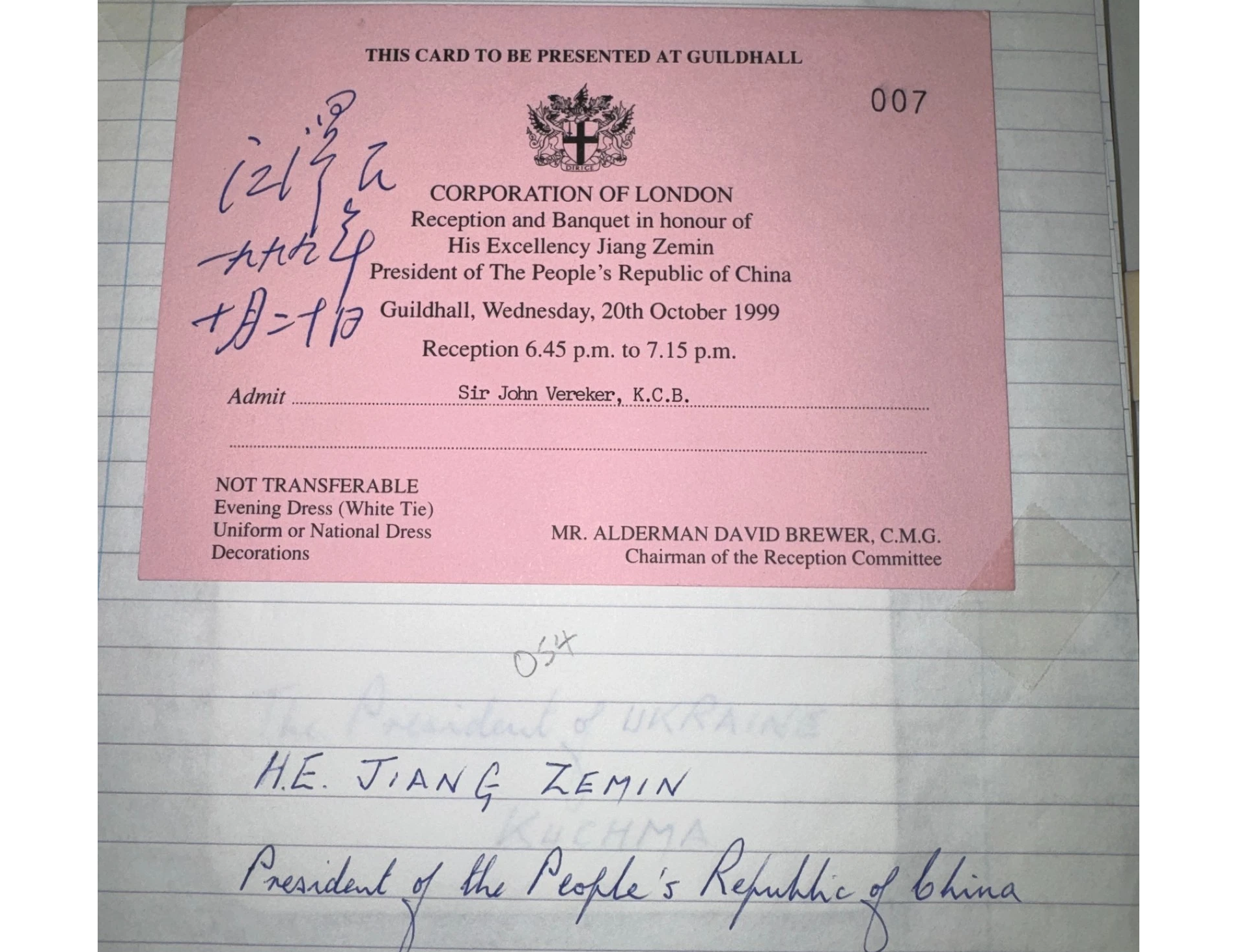
State visits generate their own small paper trails — menus, seating plans, place cards, and the quietly functional admission tickets that shepherd guests through the choreography of diplomacy. Most survive anonymously. A few, by accident or opportunity, become something more.
This pink card, Guildhall admission ticket no. 007, was issued to Sir John Vereker, K.C.B., for the City of London’s Reception and Banquet in honour of His Excellency Jiang Zemin, President of the People’s Republic of China, on 20 October 1999. The Guildhall banquet is a fixed point in the ceremonial calendar of any State Visit: the Lord Mayor, the Corporation of London, and a hall full of ministers, diplomats, and City figures marking the moment with speeches, toasts, and the full weight of civic theatre.
Jiang Zemin’s 1999 visit was diplomatically significant — the first major UK–China ceremonial engagement after the Hong Kong handover, and a showcase for renewed commercial and political ties. Security was tight, the schedule rigid, and access to the President carefully managed.
Which is why this ticket is unusual.
It comes from a large autograph collection (c. 500+) personally assembled by Mr Bernard Sullivan (1920–2017), the renowned Senior Toastmaster for the Society of London Toastmasters. Over a distinguished 58‑year career, Sullivan worked with Royalty, Heads of State, Archbishops, HM Judges, actors, politicians, sportsmen, and countless public figures — many of whom became familiar faces. Throughout this period he built up an impressive autograph collection, every signature personally obtained, and proudly shown to friends and family.
Sullivan was known for using whatever was to hand when an opportunity arose: menus, business cards, programme pages, scraps from his notes, or — as in this case — an event ticket. This particular Guildhall admission card (no. 007) was used by Sir John Vereker to enter the 1999 State Visit banquet, and was later left loose on his table during the reception. As Toastmaster, Sullivan had the freedom of the room and the informal “access all areas” that came with his role. Spotting the used ticket on Vereker’s table, he retrieved it and approached Jiang Zemin directly, obtaining a brief autograph in Chinese characters during the event.
Heads of state almost never sign items during formal engagements; the choreography simply doesn’t allow it. Yet here, on a numbered, non‑transferable Guildhall ticket that had already served its purpose, is a small handwritten trace of the President himself — a moment of opportunism, timing, and Sullivan’s characteristic charm.
The result is a curious hybrid: part diplomatic ephemera, part eyewitness souvenir, part accidental rarity. A ticket that fulfilled its intended purpose, then briefly re‑entered circulation in the hands of a man who spent decades navigating the edges of ceremonial life — and who knew exactly when to seize a moment.


Jiang Zemin (Aug 1926 – Nov 2022) was a Chinese politician who served as the general secretary of the Chinese Communist Party (CCP) from 1989 to 2002, as the chairman of the Central Military Commission from 1989 to 2004, and as the president of China from 1993 to 2003. Jiang was the fourth paramount leader of China from 1989 to 2002. He was the core leader of the third generation of Chinese leadership, one of four core leaders alongside Mao Zedong, Deng Xiaoping, and Xi Jinping.
Leave a Reply