
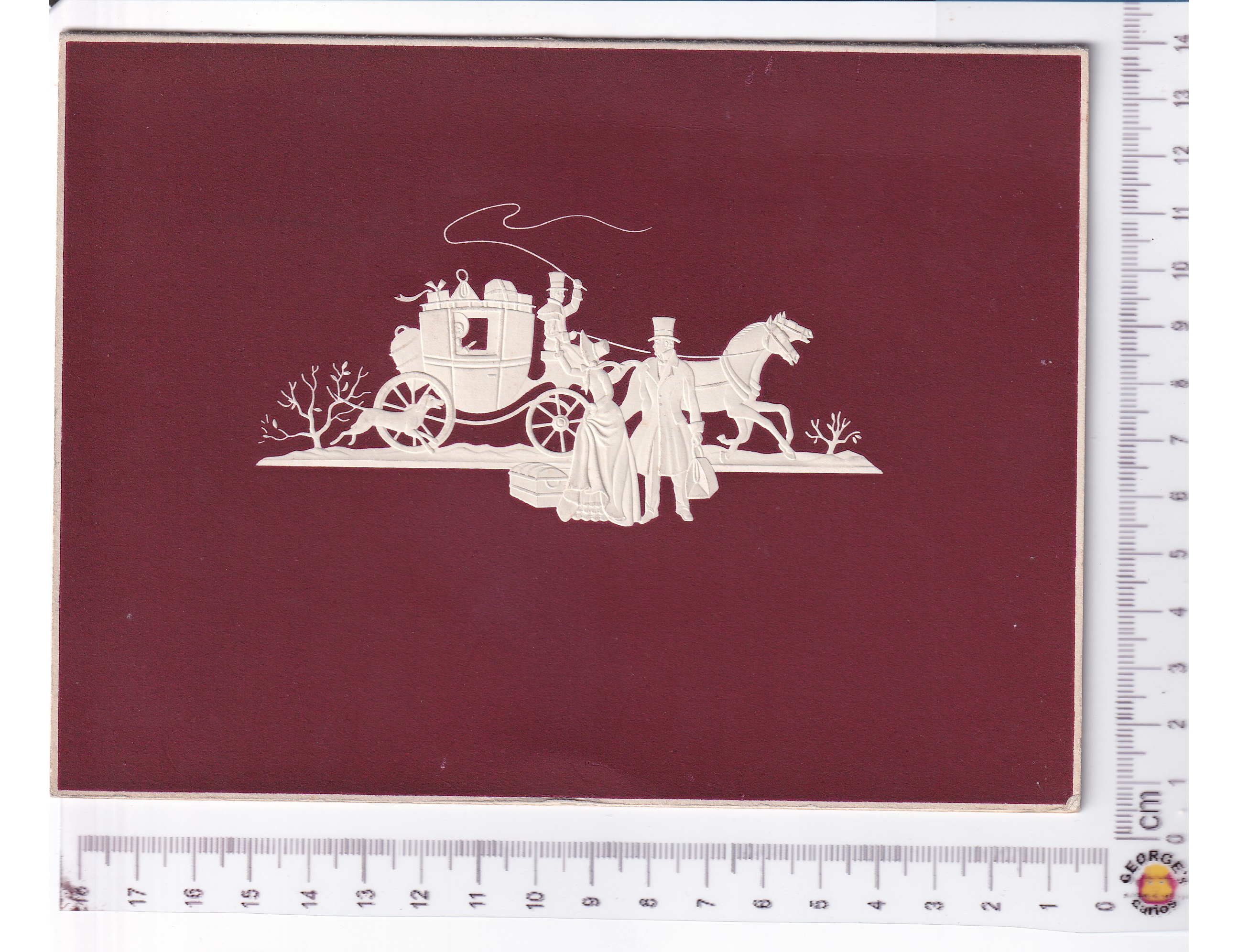
Attractive mid‑century Season’s Greetings card from Merle Oberon, retaining its original cream blind‑embossed coaching‑scene front panel mounted on card stock. The embossing shows a 19th‑century carriage with figures and foliage; crisp, commercial production typical of British greeting‑card printers of the 1940s–60s (no imprint).
Inside, printed in white on maroon:
SEASON’S GREETINGS / from / MERLE OBERON
Across this, in Merle Oberon’s hand, in black ink:
& Much love to you dear & all the family
The handwriting matches known Oberon inscriptions of the 1950s–60s: upright, slightly right‑leaning, open‑formed capitals in “Much love”. Clean, unfaded example.
From the papers of Marjorie Deans (1915–2003), writer and film‑industry figure. The card itself is unnamed, but it was found among Deans’s personal correspondence and is almost certainly addressed to her, consistent with the rest of the archive.
A good, personal Oberon manuscript item, uncommon in seasonal format.
PROVENANCE:
One of c.2,500+ items once from the collection or dealer stock of Winifred A Myers (Autographs) Ltd, St Martins Lane, London, evidenced by the quantity of Myers pre-printed envelopes and paper folders and the general ‘presentation’ of the items, many having Myers identification notes in pencil.
Winifred Alice Myers (1909 – 1985) served as ABA (Antiquarian Booksellers Assoc) president, 1950-1952. See the ABA website for an extended article on Myers. Myers left her business, in 1985, to Ruth Shepherd, who traded from home until 2004.


Merle Oberon (born Estelle Merle O’Brien Thompson; Feb 1911 – Nov 1979) was a British actress of Sri Lankan Burgher origin. Her career spanned the 1920s to the 1970s, and she was a major leading lady during the Golden Age of Hollywood
Marjorie Deans (1901–1982) was a British screenwriter, novelist, and production associate whose career bridged the studio era and the post‑war reshaping of British cinema. Beginning at British International Pictures in the mid‑1930s, she contributed to roughly twenty films, ranging from historical dramas to literary adaptations, and became a key collaborator of producer Gabriel Pascal. Her work as scenario editor and script supervisor on Caesar and Cleopatra (1945) placed her among the small cohort of women holding senior creative roles in the industry, shaping narrative structure and continuity at a time when such positions were overwhelmingly male‑dominated. Beyond film, Deans published three novels and wrote Meeting at the Sphinx (1946), a memoir offering an unusually candid account of the challenges and eccentricities of mid‑century film production. She later adapted Trollope for the BBC and undertook translation work before retiring from public life. Her career, long overlooked, is now recognised as an important example of early female authorship and behind‑the‑scenes influence in British cinema. For more info search grokipedia dot com for ‘Marjorie Deans’ (there are 2 pages of extensive history)
Leave a Reply