
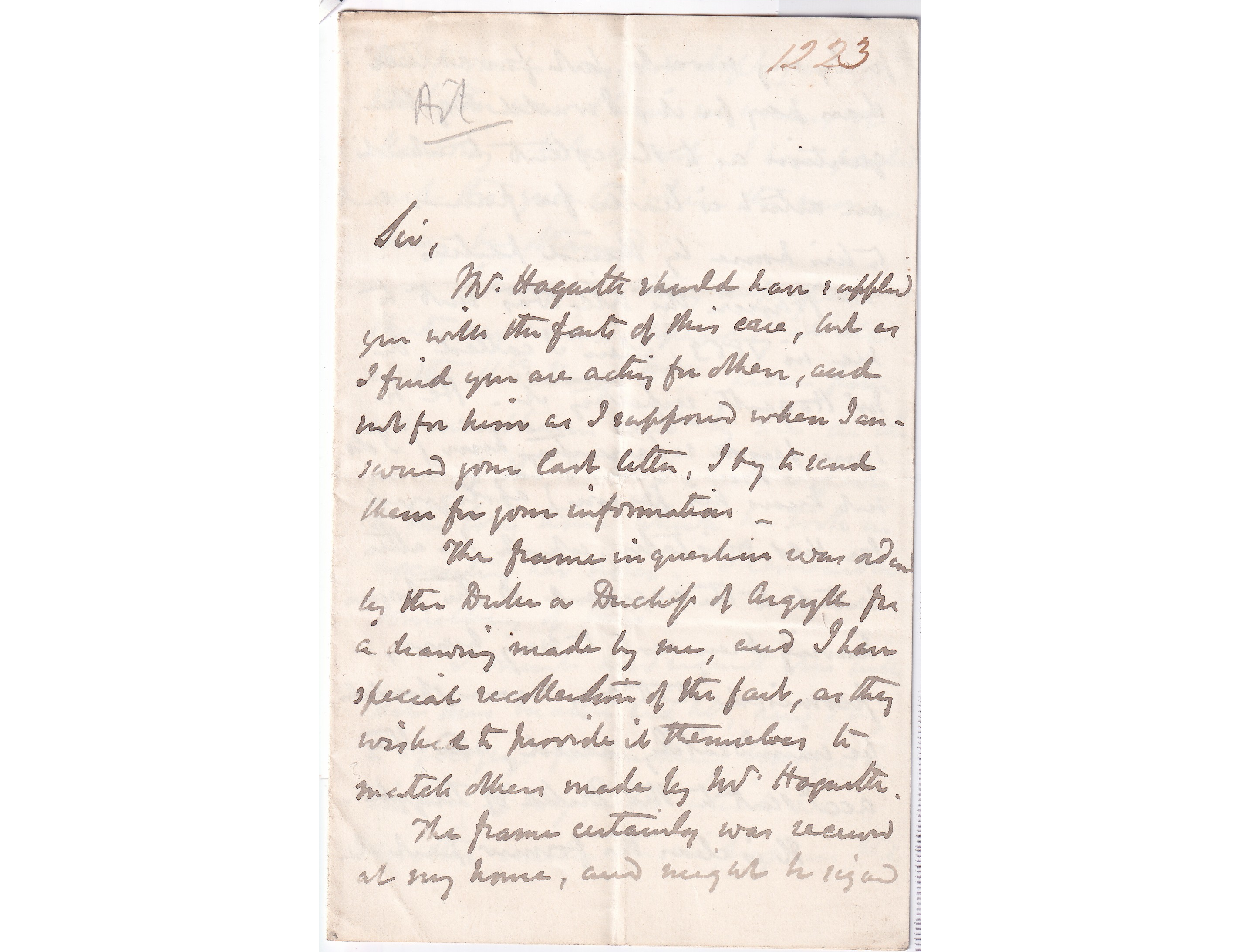
TEvery so often, a modest Victorian letter turns out to illuminate a corner of art history that no published source has ever quite captured. A recently surfaced 1855 autograph letter by the portrait draughtsman Eden Upton Eddis (1812–1901) does exactly that: it documents an otherwise unrecorded commission for the Duke and Duchess of Argyll, and a quietly revealing dispute with the celebrated London framemakers Hogarth & Sons.
Eddis is best known today for his refined portrait drawings of aristocratic and professional sitters, many of which were engraved for Victorian gift books and periodicals. Working from 57 Harley Street, he built a steady practice among London’s elite, producing sensitive likenesses — especially of children — for private family albums. His correspondence rarely survives, and when it does, it tends to be polite, businesslike, and discreet. Which is why this letter stands out.
In it, Eddis explains that a frame ordered by the Duke and Duchess of Argyll for a drawing he had made was mistakenly delivered to his house and charged to him. The frame had been commissioned from Hogarth & Sons, one of the leading framemakers of mid‑19th‑century London. Hogarth’s firm, well documented in the National Portrait Gallery’s directory of British framemakers, supplied carved and gilt frames to Royal Academy exhibitors and aristocratic households alike. Their practice of delivering frames directly to artists’ studios on behalf of patrons was common — and, as Eddis’s letter shows, occasionally problematic.
Eddis recounts visiting Hogarth in 1853, receiving an apology “for their mistake,” and being assured that his name would be removed from the account and the charge redirected to the Argylls. Two years later, the correction still had not been made. His 1855 letter is a polite but firm attempt to set the matter right, noting that he has “furnished all the quarters where the money may be obtained.” It is a rare glimpse into the administrative frictions that lay behind the polished surfaces of Victorian portraiture.
What makes the letter especially valuable is that it records a previously unknown Argyll family drawing by Eddis. No portrait of the Duke, Duchess, or their children by Eddis appears in exhibition catalogues, museum holdings, or auction records. Yet here is primary evidence that such a work existed — important enough for the Argylls to commission a matching Hogarth frame. Whether the drawing survives in the Argyll family papers or has long since disappeared, the letter anchors it firmly in the historical record.
For collectors and historians of Victorian art, this small document opens a window onto the working relationships between artists, patrons, and framemakers in mid‑century London. It reminds us that behind every gilt frame and every aristocratic portrait lies a network of negotiations, deliveries, misunderstandings, and — occasionally — a politely worded complaint from 57 Harley Street.
PROVENANCE:
One of c.2,500+ items once from the collection or dealer stock of Winifred A Myers (Autographs) Ltd, St Martins Lane, London, evidenced by the quantity of Myers pre-printed envelopes and paper folders and the general ‘presentation’ of the items, many having Myers identification notes in pencil.
Winifred Alice Myers (1909 – 1985) served as ABA (Antiquarian Booksellers Assoc) president, 1950-1952. See the ABA website for an extended article on Myers. Myers left her business, in 1985, to Ruth Shepherd, who traded from home until 2004.


Eden Upton Eddis (1812–1901)
Eden Upton Eddis was a London portrait painter and draughtsman, trained at the Royal Academy Schools and active from the 1830s to the 1870s, known for refined portrait drawings of aristocratic, political, and professional sitters. Working from 57 Harley Street, he exhibited regularly at the Royal Academy and produced numerous private commissions, particularly sensitive likenesses of children and family groups. His work was widely engraved, and his surviving correspondence shows the practicalities of Victorian portrait practice, including dealings with framemakers, patrons, and intermediaries. The present letter documents an otherwise unrecorded commission for the Duke and Duchess of Argyll and illustrates Eddis’s careful management of studio accounts and patron‑supplied framing.
Hogarth & Sons (fl. mid‑19th century)
Hogarth & Sons were one of the leading London framemakers and print‑publishers of the mid‑19th century, operating from Haymarket and later the Strand, and are well documented in the National Portrait Gallery’s directory of British framemakers. Known for high‑quality carved and gilt frames, distinctive mouldings, and extensive trade with Royal Academy exhibitors, they supplied both artists and aristocratic households, often delivering frames directly to studios on behalf of patrons. Their labelled frames survive in major museum collections and are characteristic examples of mid‑Victorian London craftsmanship. The firm’s practice of routing patron‑commissioned frames through artists’ addresses occasionally produced administrative disputes, one of which is recorded in Eddis’s 1855 letter concerning a frame ordered by the Duke and Duchess of Argyll.
Leave a Reply