
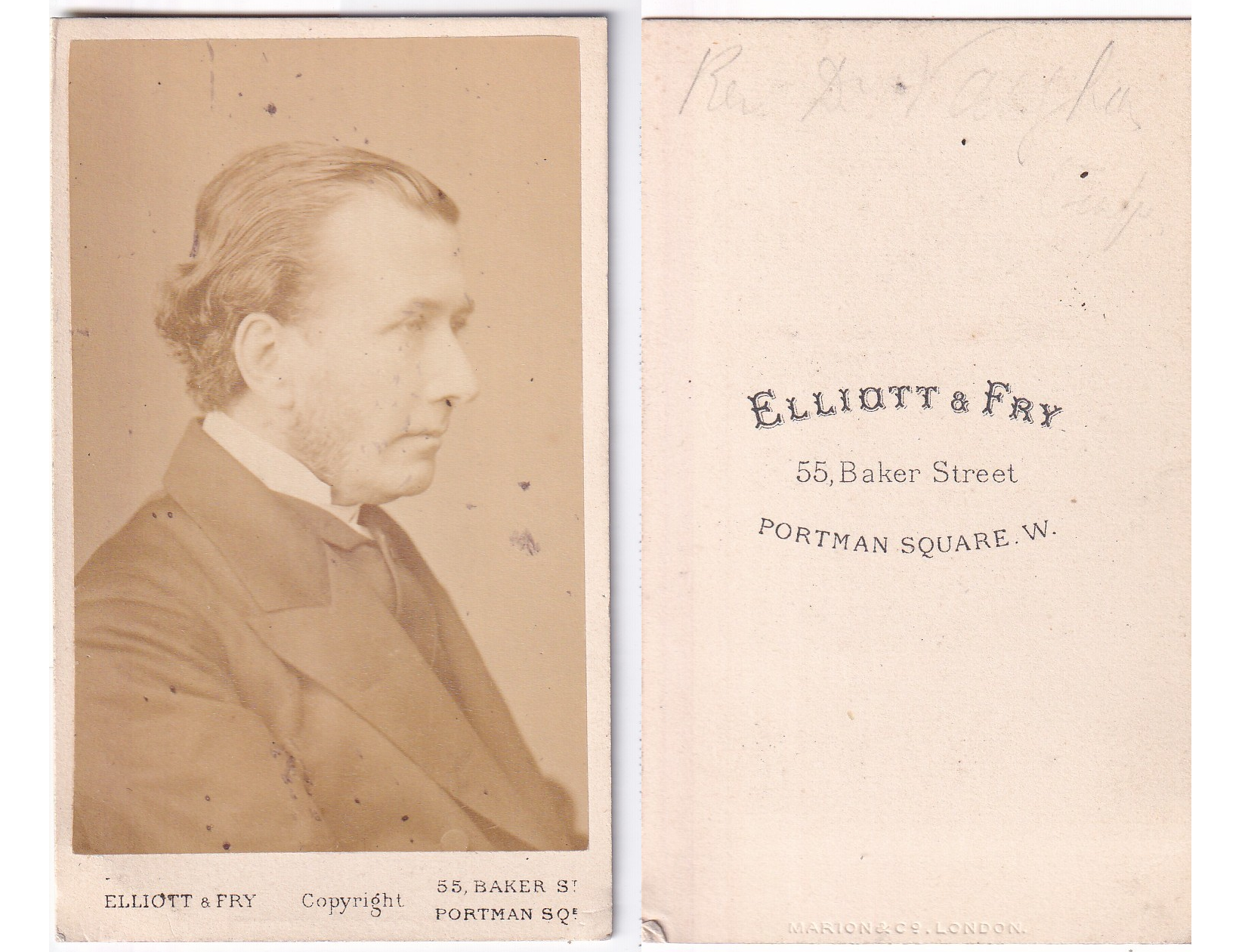
Some cartes de visite feel more like small historical statements than simple portraits. This profile of Charles John Vaughan (1816–1897)—educator, preacher, and long‑serving Master of the Temple—is one of those compact survivors that still carries its subject’s Victorian authority.
Vaughan was already a major figure when he sat for Elliott & Fry, the Baker Street studio known for photographing Britain’s public men. Their restrained vignette style suits him: the calm profile, the soft fade into blank space, the sense of a character shaped by scholarship and duty. It’s the kind of image that circulated among colleagues, institutions, and admirers during the height of his influence.
The card bears the firm’s 55 Baker Street imprint and the Marion & Co. blindstamp—hallmarks of Elliott & Fry’s 1870s–1880s production. A pencilled “Rev Dr Vaughan” on the verso adds a small human touch, the sort of practical identification made by early owners rather than the studio.
Today, the photograph reads as a distilled Victorian ideal: public seriousness rendered in profile, captured by one of London’s most accomplished portrait houses. For collectors of ecclesiastical history, Harrow School, or nineteenth‑century photography, it’s a quietly compelling piece of the period’s visual culture.


Charles John Vaughan (1816 – 1897) — influential Anglican educator and preacher, former Headmaster of Harrow and long‑serving Master of the Temple.
Elliott & Fry (est. 1863) — leading London portrait studio famed for photographing Victorian public figures from its Baker Street rooms.
Leave a Reply